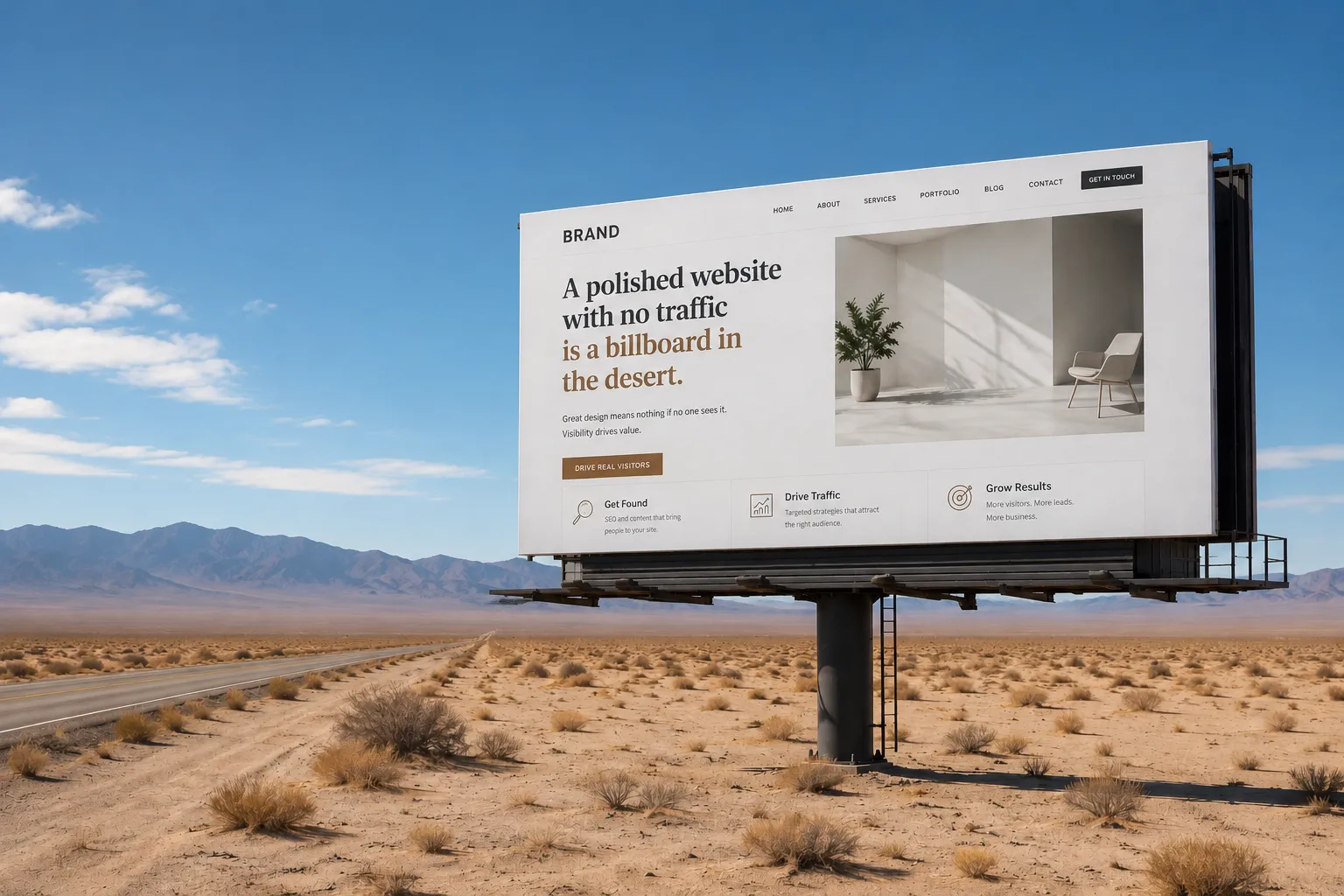
You spent months planning your website. You hired a designer, a developer turned the mockups into a polished product, and the bill reached five figures. Then you launched, and nothing happened. No steady traffic, no inquiries, no sales, no return on the investment. If that sounds familiar, the problem is almost never the design.
Building a website is no longer the difficult part. WordPress, Shopify, Webflow, and thousands of capable developers have made launching a professional site fast and affordable. The challenge starts the day it goes live, because a new site is not automatically visible to anyone. Google does not rank it just for existing, customers do not stumble onto the homepage, and social feeds send nobody unless you give them a reason. A website is a foundation. Traffic is what turns that foundation into a business asset, and almost nobody budgets for the traffic.
The Real Cost of a Website Nobody Finds
The gap between a site that looks good and a site that earns money is not aesthetic, it is a gap in visibility and patience. The numbers below frame why an expensive build with no marketing plan produces so little.
53%
of mobile visitors leave
a site slower than 3s
46%
of Google searches
carry local intent
73%
of page-one results are
more than 3 years old
3-6 mo
typical time for a page
to reach page one
Read together, these say something specific. Half your visitors leave before a slow page even loads. Nearly half of all search demand is local, which is winnable but only if search engines can confirm where you are. And rankings take months, not days, so a site abandoned in its first quarter never reaches the point where it pays off.
A Website Is Not a Marketing Strategy
Many owners treat a website like opening a physical store, assuming customers arrive because the doors are open. The internet does not work that way. More than a billion websites compete for attention, and thousands more launch every day. A new domain has no rankings, no audience, and no referring links pointing at it, so it sits unseen until something changes.
That something is distribution. Search, local listings, content, email, referrals, and paid media are the roads that carry people to your door. Without at least one of them running, the most beautiful homepage in your industry reaches the same audience as a billboard in the middle of a desert: nobody.
Design Builds Trust. Traffic Builds Revenue.
A beautiful site builds trust, a fast site improves experience, and a responsive site works on every device. All of that matters, and none of it brings a single visitor on its own. You can spend a fortune on custom design, premium photography, and animation, and if nobody sees the site, that spend produces little business value.
The chain is simple and unforgiving. Without traffic there are no leads, without leads there are no customers, and without customers your website is an expensive digital brochure. Design decides whether a visitor stays and trusts you. It cannot decide whether a visitor shows up in the first place.
Before You Market Anything, Make the Site Worth Visiting
Sending traffic to a site that cannot convert it is the most common waste of marketing effort there is. Fix three things before you spend a peso on promotion.
Speed and Mobile
Most Filipinos browse on a phone over mobile data, so a heavy, slow site loses buyers before it renders. Research from Google found that 53 percent of mobile visitors abandon a site that takes longer than three seconds to load, and the probability of a bounce rises sharply as load time climbs from one second to three. Compress your images, cut unused third-party scripts, and test on a mid-range phone on mobile data rather than on office wifi.
Trust Signals
A new business earns trust through evidence, not polish. That means a real About page, a visible phone number and address, clear pricing or a clear path to a quote, and a short FAQ that answers the two questions every first-time customer has: is this business real, and what happens if something goes wrong. Showing your DTI or SEC registration status reassures buyers, and it is worth confirming which one applies to you before you display it.
The One Number That Matters
Your conversion rate. If visitors arrive and almost none inquire or buy, you do not have a traffic problem yet, you have a page problem. Spending on ads or content while the page leaks means building a pipeline that drains. Fix the page, then open the taps.
Google Ranks Value, Not Looks
Google has one goal: return the best answer to a search. Your site earns visibility by proving its value against signals the algorithm can read. Design supports those signals. It does not replace them.
- Helpful, specific content that answers real queries
- Relevant keywords used naturally, not stuffed
- Quality backlinks from relevant sites
- Strong internal linking between related pages
- A fast, stable, positive user experience
- Local relevance confirmed by consistent citations
- Fresh information, updated rather than left to age
- Authority built over time within your industry
A stunning site that meets none of these ranks below a plain one that meets most of them. That is not a flaw in the system, it is the system working as intended: rewarding usefulness over decoration.
Local Search and Backlinks: The Two Signals You Cannot Build Alone
Two of Google's strongest signals are almost impossible to build from your own website. You cannot link to yourself and call it authority, and you cannot tell Google you are a real, established local business and expect it to take your word for it. Both signals have to come from outside your own domain, which is exactly the work a business directory does that your homepage cannot.
Local Citations
A local citation is a consistent record of your business name, address, and phone number on a trusted third-party site. Google reads those citations as corroboration that your business exists, operates, and sits where you say it does. With 46 percent of searches carrying local intent, and the majority of local searchers contacting a business within a day, a clean citation footprint is how you get counted in the results those searches return. Consistency of your name, address, and phone across every listing is what strengthens your standing in the map pack, and a single mismatched detail weakens it.
Relevant Backlinks
A listing also earns you a backlink from a real referring domain. Not every backlink carries the same weight. A link from a random, off-topic page does little, while a link from a directory that shares your geography and your category signals genuine relevance, and relevance is what Google rewards. A geo and category relevant citation is the kind that counts rather than the kind that adds noise.
Where azifind.com Fits
azifind is a Philippine business directory built around geography, with region, province, and city pages that rank for the location-specific searches your customers actually type. A verified listing does three things in one step. It creates a local citation with consistent name, address, and phone details. It earns a geo and category relevant backlink from a directory focused on the same market you serve. And it puts your business on a city and category page where people already searching for what you offer can find you, which is a discovery channel your own site does not have on its own.
azifind's Largest Categories, by Verified Listings
A directory customers already browse is a directory worth appearing in. Nearly 29,600 businesses are listed across the Philippines.
Listing counts current as of publication, azifind.com business directory.
Find the Category Where Your Business Belongs
azifind organizes listings by industry so customers can browse straight to what they need. Some categories are already deep, which means active traffic. Others are nearly empty, which means an open field where an early listing has little competition. Both are reasons to claim your spot now.
The Plan: Four Phases From Launch to Traffic
Marketing a website is a sequencing problem more than a budget problem. The order matters: foundation before amplification, organic validation before paid spend, retention before scale. Each phase needs the one before it to be working before it returns anything.
From Launch Day to a Compounding Asset
Four phases, run in order. Launch day is the start of the work, not the finish line.
Foundation
BuildOn-page SEO, blog content, Google Business Profile, local citations on directories like azifind, sitemap in Search Console. Costs time, not ad money.
Amplification
GrowEmail list and welcome sequences, targeted outreach, local PR and partnerships, and paid ads only after the page proves it converts organic traffic.
Retention
CompoundNurture and post-purchase email, retargeting the warm audience, steady reviews, and backlink outreach to relevant sites. Repeat business compounds.
Iterate
ScaleAnalytics and Search Console as the decision input, conversion rate optimization, content refresh, and catalog or service expansion based on real query data.
Notice where azifind sits. Claiming your listing is a foundation move, one of the earliest, cheapest wins available, and it keeps working through every later phase as a standing citation and a source of directory traffic.
| Channel | Primary job | When to start |
|---|---|---|
| SEO and content | Compounding organic discovery | Foundation, first |
| GBP and citations | Local search and map pack visibility | Foundation, first |
| Owned audience and repeat sales | Amplification | |
| Backlink outreach | Authority and relevance signals | Amplification to Retention |
| Paid ads | Fast, validated traffic | After organic converts |
| Reviews | Prominence and buyer trust | Retention, ongoing |
The Realistic Timeline, Month by Month
The most common reason a marketing effort fails is stopping at month three or four, which is consistently the month before organic traffic begins to arrive for sites that did the foundation correctly.
| Phase | Months | Focus | On-track signal |
|---|---|---|---|
| Foundation | 1 to 3 | SEO, content, GBP, citations, Search Console | Pages appearing in Search Console impressions |
| Early signals | 3 to 6 | Email list, first sequences, outreach begins | First organic inquiries from content and local search |
| Amplification | 6 to 9 | Paid ads if validated, PR, backlink outreach | Positive return on at least one paid channel |
| Compounding | 9 to 12 | Retargeting, reviews, refresh, community | Organic traffic growing without new posts |
| Scale | 12+ | Expansion, lookalike audiences, partnerships | Organic revenue exceeding paid spend in a channel |
Month four is when most people quit. The blog has a handful of posts, the list has a few dozen subscribers, and revenue looks flat, so it feels like nothing is working. It is working. Ahrefs found that the large majority of page-one results are more than three years old, because Google's trust in a page builds slowly. A page sitting at position eighteen in month three commonly sits at position nine in month six and position four in month nine. Compounding needs time, and the businesses winning online are the ones that kept investing in visibility long after launch and did not quit in month four.
One Last Thing
Your five-figure website is not worthless because of its design. It is worthless when nobody visits it. A website is the foundation, and traffic, local search, and referring domains are what turn that foundation into a business asset. Start with the cheapest, fastest wins in local search, make sure your business is findable where people already search, and keep going past the month where most give up. For a business serving Philippine customers, claiming your azifind listing is one of those first wins, and it costs nothing but a few minutes.
Frequently Asked Questions
Why is my expensive website not getting any traffic?
Because a website is a foundation, not a marketing strategy. Design earns trust once someone arrives, but it does not bring anyone. Traffic comes from search visibility, local citations, backlinks, content, email, and paid channels that you build after launch. A site with no post-launch marketing plan stays invisible no matter how much it cost.
How long does it take to get traffic to a new business website?
For a site doing consistent on-page SEO, content, and local citation work, the first meaningful organic traffic usually appears between months three and six. Ahrefs data shows most page-one results are more than three years old, so new pages take patience. First impressions in Google Search Console often show within four to eight weeks if the sitemap is submitted and the pages target specific, low-competition queries.
What is the difference between a backlink and a local citation?
A backlink is any link from another website to yours, and its value depends on the linking site relevance and authority. A local citation is a mention of your business name, address, and phone number on a third-party site, which confirms to Google that your business is real and located where you claim. A directory listing can deliver both at once.
Do I need to pay for ads to get customers?
No. Paid ads accelerate a working organic strategy, they do not replace one. Many businesses generate steady inquiries from local search, content, and referrals alone. Ads work best once your pages already convert, because you then know you are paying for clicks that turn into customers rather than clicks that leak.
How does listing on a directory help my Google ranking?
A listing on a relevant directory creates a consistent local citation and a geo and category relevant backlink. Both are ranking signals that are difficult to build from your own domain. Consistency of your name, address, and phone number across your site, your Google Business Profile, and directories strengthens your position in local search and the map pack.
What should I do first if I already have a website but no visitors?
Make sure the site loads fast and converts, claim and complete your Google Business Profile, then build consistent local citations on trusted directories such as azifind for the Philippine market. Those three moves address the fastest wins in local search before you invest in content and paid channels.
List your business where buyers are already searching
Claim or add your free listing on azifind to build a local citation, earn a relevant backlink, and appear on the city and category pages people use to find businesses like yours. It is one of the fastest wins in local search, and it costs nothing.