Key Takeaways
- NCR splits into four functional business districts, and each has settled into a distinct industry specialty rather than competing head-on.
- Quezon City, Makati, and Manila are the three trillion-peso city economies in NCR as of 2024 PSA data, though Makati leads by a wide margin on GDP per person.
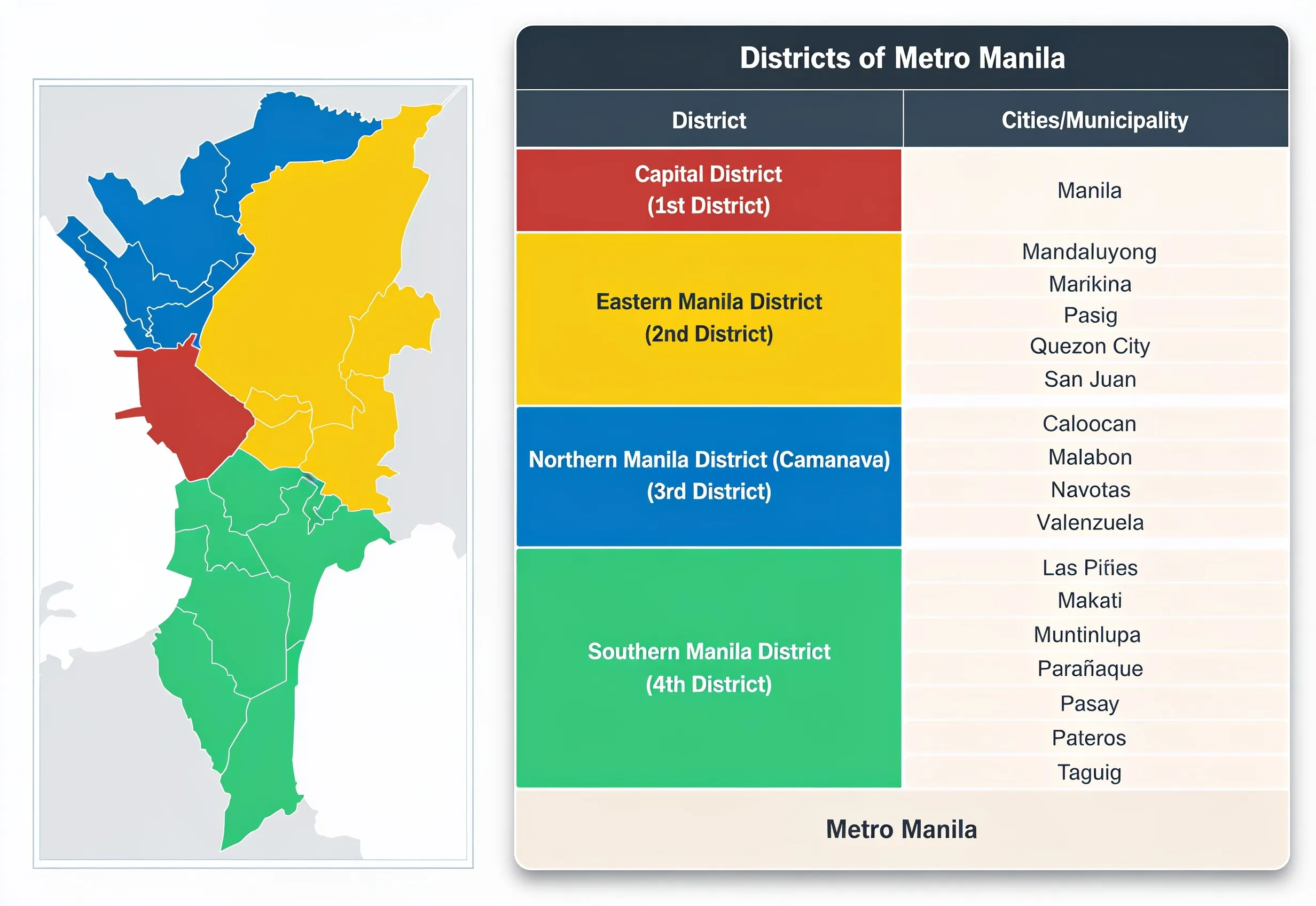
- The Southern District (Makati, BGC, the Bay Area) concentrates finance, corporate HQs, and BPO; the Eastern District (Ortigas, Eastwood) leans media and services; the Capital District (Manila) runs on trade, logistics, and port operations; and the Northern District (CAMANAVA) is NCR's industrial and manufacturing base.
- Where a business locates in NCR affects more than rent: it changes access to talent, hospital density, and commute times for staff.
Figures from PSA's 2024 Provincial Product Accounts and 2024 Census of Population.
Metro Manila, officially the National Capital Region, is the economic engine of the Philippines, generating over 30 percent of national GDP from a land area smaller than most single provinces. But NCR is not one economy. It is 16 cities and a municipality, each with its own council, budget, and industry base, loosely grouped into four geographic districts for planning purposes.
That grouping matters for anyone deciding where to locate a business, hire staff, or open a branch office. A finance company and a manufacturer both technically operate "in NCR," but they belong in very different parts of it. Below is a breakdown of the four districts, their dominant industries, the cities that make them up, and where each ranks on GDP, growth, and quality of life.
NCR Cities Compared: GDP, Growth, and Industry
The table below draws on the Philippine Statistics Authority's 2024 Provincial Product Accounts, the first year PSA compiled full city-level GDP figures for NCR. Figures are at constant 2018 prices.
| City | District | 2024 GDP | 2024 Growth | Dominant Industry |
|---|---|---|---|---|
| Quezon City | Eastern | ₱1.33 trillion | 4.4% | Media, IT-BPM, education, government |
| Makati City | Southern | ₱1.20 trillion | 7.3% | Finance, corporate HQs, BPO |
| Manila City | Capital | ₱1.04 trillion | 5.2% | Wholesale trade, logistics, port operations |
| Pasig City | Eastern | Top 5 NCR economy | 6.5% | Corporate offices, retail, BPO |
| Taguig City | Southern | ₱656.3 billion | 4.7% | Tech, healthcare BPO, financial services |
| Parañaque City | Southern | ₱366.4 billion | 6.8% | Gaming, entertainment, airport-linked logistics |
| Pasay City | Southern | ₱359.1 billion | 6.6% | Tourism, integrated resorts, MICE |
| Mandaluyong City | Eastern | ₱320.4 billion | 6.4% | Retail, corporate offices (Ortigas Center) |
| Caloocan City | Northern (CAMANAVA) | Mid-tier NCR economy | 6.1% | Manufacturing, wholesale trade, warehousing |
| Valenzuela City | Northern (CAMANAVA) | ₱179.0 billion | 6.0% | Manufacturing, footwear and garments, logistics |
| Muntinlupa City | Southern | Growing steadily | 3.2% | BPO, pharmaceuticals, healthcare |
| Las Piñas City | Southern | ₱117.0 billion | 4.4% | Retail, residential-linked services |
| Marikina City | Eastern | Smaller NCR economy | 2.7% | Footwear manufacturing, light industry |
| Malabon City | Northern (CAMANAVA) | ₱72.3 billion | 7.3% | Wholesale trade, small manufacturing |
| San Juan City | Eastern | Smallest land area in NCR | Steady growth | Retail, medical services, real estate |
| Navotas City | Northern (CAMANAVA) | Smallest NCR economy | 2.9% | Commercial fishing, fish port and cold storage |
GDP and growth figures from PSA Provincial Product Accounts, 2024 Economic Performance of the Highly Urbanized Cities in the Philippines, at constant 2018 prices. Some smaller cities' exact GDP levels were not individually disclosed in the release cited here; those rows are marked qualitatively instead.
1. Southern District
Cities: Makati, Taguig, Pasay, Parañaque, Muntinlupa, Las Piñas, Pateros
Dominant industries: Financial services, corporate headquarters, information technology, and BPOs.
This is where the country's money sits. The Makati Central Business District remains the Philippines' premier financial hub, home to the country's largest banks and the headquarters of conglomerates like Ayala Corporation and Metrobank. It also posted the fastest GDP growth of any major NCR city in 2024, at 7.3 percent, and holds the highest per capita GDP in the entire country.
Bonifacio Global City in Taguig has grown into the district's newer anchor for multinational tech firms, healthcare BPO, and corporate investment, drawing companies that want modern, PEZA-accredited towers over Makati's older stock. Meanwhile the Bay Area straddling Pasay and Parañaque has become the district's growth engine for integrated resorts, gaming, and MICE tourism, and Muntinlupa's Alabang has carved out its own niche in pharmaceuticals and BPO thanks to its access to talent from Laguna and Cavite.
Pinned: Makati CBD, Bonifacio Global City, and Alabang, Muntinlupa.
2. Eastern District (Eastern Manila)
Cities: Quezon City, Pasig, Mandaluyong, Marikina, San Juan
Dominant industries: Media and broadcasting, BPOs, telecommunications, and retail and commerce.
Ortigas Center, which spills across Pasig, Mandaluyong, and a corner of Quezon City, functions as a second financial and retail capital for the metro, hosting the Asian Development Bank, San Miguel Corporation, and the Philippine Stock Exchange's former headquarters. Quezon City, NCR's largest city by both population and GDP, anchors the country's media networks (ABS-CBN and GMA Network are both headquartered there), several of its top universities, and large-scale IT parks like Eastwood City and the UP-Ayala Land TechnoHub.
Marikina and San Juan are smaller economies within this district but carry their own specialties: Marikina remains the historic center of Philippine footwear manufacturing, while San Juan's compact land area is built out almost entirely for retail and medical services.
Pinned: Ortigas Center, Eastwood City, and the Araneta Center.
3. Capital District
City: Manila (City of)
Dominant industries: Wholesale and retail trade, logistics and warehousing, port operations, and tourism and hospitality.
As NCR's historical and institutional center, Manila carries a different kind of economic weight than the Southern or Eastern districts. Binondo, the world's oldest Chinatown, remains a working center for wholesale gold, gemstone, and general merchandise trade. The Port of Manila handles a large share of the country's international and domestic shipping, and the city's economy still leans heavily on MSMEs and traditional retail rather than corporate towers, which is part of why Manila posted a GDP of nearly a trillion pesos in 2023 despite a comparatively modest office stock.
Intramuros and the surrounding heritage district anchor historical and educational tourism, while the presence of the University of Santo Tomas, the University of the Philippines Manila, and several other major universities makes education a quiet but steady contributor to the city's services economy.
Pinned: Binondo, the Port of Manila, and Intramuros.
4. Northern District (CAMANAVA)
Cities: Caloocan, Malabon, Navotas, Valenzuela
Dominant industries: Manufacturing, food and beverage production, logistics, and wholesale trade.
CAMANAVA is NCR's industrial base, and it looks and functions differently from the other three districts. Valenzuela and Caloocan house the bulk of NCR's remaining factories and warehousing capacity, particularly in garments, footwear, and light manufacturing, sectors that mostly left Makati and Manila decades ago. Navotas is a category of its own: it hosts the Navotas Fish Port Complex, the country's largest fish trading center, and functions as the hub for Metro Manila's commercial fishing and aquatic distribution industries.
This district posts the slowest and most uneven growth of the four, with Marikina-adjacent Navotas and neighboring cities growing under 3 percent in 2024 even as Malabon, on the same list, posted the fastest growth in the region at 7.3 percent, a reminder that CAMANAVA is not one uniform economy either.
Pinned: Valenzuela's industrial corridor, the Navotas Fish Port Complex, and Caloocan City.
Healthcare Access and Benefits of Living in Each District
Where a business sets up affects where its employees end up living, and hospital access and commute time are two of the biggest quality-of-life factors people weigh when choosing a city in NCR. Here is a rough read on each district.
| District | Major Hospitals | Benefits of Living There |
|---|---|---|
| Southern | Makati Medical Center, St. Luke's Medical Center Global City, Asian Hospital and Medical Center | Highest household incomes in the country, shortest commutes for CBD workers, densest concentration of malls, schools, and lifestyle amenities |
| Eastern | The Medical City, St. Luke's Medical Center Quezon City, Philippine Heart Center, Cardinal Santos Medical Center | Largest talent pool for hiring, widest range of housing price points, strong university access for families |
| Capital | Philippine General Hospital, Manila Doctors Hospital, Chinese General Hospital | Lowest cost of living relative to job density, access to major public tertiary hospitals, strong public transit connections |
| Northern (CAMANAVA) | Valenzuela Medical Center, Caloocan City Medical Center, Tondo Medical Center (bordering Manila) | More affordable housing and commercial rents than the other three districts, proximity to Bulacan and Central Luzon supply chains |
Hospital lists are indicative of major tertiary facilities in or near each district, not exhaustive. Confirm accreditation and specialty coverage directly with a facility before relying on it for a specific medical need.
One Last Thing
No district in NCR is right for every kind of business. The Southern District still carries the country's deepest finance and BPO bench, the Eastern District offers the largest talent pool and media presence, the Capital District keeps trade and logistics moving through the port, and the Northern District is where the region's remaining manufacturing capacity lives. The right starting point depends on the industry, the budget, and how much weight a company puts on commute time versus rent.
Once you know which district fits, browse verified business listings on azifind.com to see who is already operating there.
Frequently Asked Questions
How many business districts does Metro Manila have?
Metro Manila is commonly grouped into four geographic districts for business purposes: Southern, Eastern, Capital, and Northern (CAMANAVA), each with its own dominant industries and cities.
Which NCR city has the largest GDP?
Quezon City recorded the largest economy among NCR cities in 2024 at roughly 1.33 trillion pesos, followed by Makati City at around 1.20 trillion pesos and Manila City at just over 1 trillion pesos.
Which NCR city has the highest per capita GDP?
Makati City has the highest per capita GDP of any city in the Philippines, driven by its concentration of corporate headquarters, banks, and BPO operations relative to its comparatively small resident population.
Which district is best for BPO and IT companies in NCR?
The Southern District leads for BPO and IT, anchored by Bonifacio Global City in Taguig and the Makati CBD, though Eastern District hubs like Ortigas Center and Eastwood City in Quezon City also host a large concentration of delivery centers.
NCR Quick Facts
What is the richest district in Metro Manila?
The Southern District is the richest by most measures, anchored by Makati City, which has the highest per capita GDP of any city in the Philippines thanks to its concentration of banks and corporate headquarters.
What are the 4 districts of NCR?
For business and planning purposes, NCR is grouped into the Southern District, Eastern District, Capital District, and Northern District, also known as CAMANAVA (Caloocan, Malabon, Navotas, Valenzuela).
Which geographic zone of NCR is most suitable for urban development due to its solid foundation and infrastructure?
The Guadalupe Plateau is considered the most adaptable zone for urban development in NCR because of its solid geological foundation and its existing infrastructure links to the rest of Luzon.
What is the geographic profile of NCR?
NCR lies along flat alluvial lands stretching from the mouth of the Pasig River to the higher rugged terrain of the Marikina Valley, and is divided into four zones: the Coastal Margin facing Manila Bay, the Guadalupe Plateau, the Marikina Valley, and the Laguna Lowlands. The region also sits near several active fault systems, including the Marikina Valley Fault System.
What's the poorest city in Metro Manila?
By total GDP level, cities like Navotas and Marikina post the smallest economies among NCR's 16 highly urbanized cities. This reflects the size of their local economies, not a formal poverty ranking, which PSA measures separately through poverty incidence data.
Who is the richest city in NCR?
Makati City has the highest per capita GDP in NCR and the country, while Quezon City has the largest total GDP of any NCR city. Which one counts as "richest" depends on whether the measure is per capita output or total economic size.
What is the NCR 2nd district?
NCR doesn't use a single numbered district system across the whole region. If the question refers to the four business districts covered here, the "2nd" would be the Eastern District. If it refers to congressional districts, each NCR city has its own separately numbered districts, such as Manila's 2nd congressional district, which covers the eastern part of Tondo known as Gagalangin.
What is the first district of Manila?
Manila's 1st congressional district covers the western part of Tondo, along Manila Bay. It's the city's most densely populated district and includes the Manila North Harbor.
What is the largest city in Metro Manila?
Quezon City is the largest city in Metro Manila by both land area and population, with over 3 million residents as of the 2024 census.
What are the highly urbanized cities in NCR?
All 16 cities in Metro Manila are classified as highly urbanized cities under Section 452 of the Local Government Code, which automatically designates every city within Metro Manila as an HUC. Pateros is the only municipality in the region and is not an HUC.
Is NCR rural or urban?
NCR is entirely urban. It's the only fully urbanized region in the Philippines, with all of its constituent cities classified as highly urbanized and no rural population component.
What is Metro Manila known for?
Metro Manila is known as the seat of the national government, the country's financial and BPO center, its densest population concentration, and home to historic sites like Intramuros and Rizal Park alongside major shopping and business districts.
What is the only town in Metro Manila?
Pateros is the only municipality, or town, in Metro Manila. Every other local government unit in the region is a city.
What is NCR known for?
NCR is known as the Philippines' political and economic capital, generating over 30 percent of national GDP, hosting the headquarters of most major companies and government agencies, and serving as the country's primary BPO and finance hub.
What is the best city to live in NCR?
There's no single best city; it depends on priorities. Makati and BGC in Taguig are often cited for safety and amenities, San Juan and Marikina for a quieter residential feel with good hospital access, and Quezon City for its range of housing price points.
How many districts does NCR have?
NCR is informally grouped into 4 geographic business districts: Southern, Eastern, Capital, and Northern (CAMANAVA). There's no formal administrative "district" tier between the region and its 17 local government units.
What is the economy of NCR?
NCR is the Philippines' largest regional economy, contributing roughly 31 percent of national GDP in 2024. Its economy is dominated by services, particularly finance, BPO, wholesale and retail trade, and real estate.
Which city is famous in NCR?
Manila is famous as the historical and official capital city, while Makati is famous as the country's financial center. Which one comes to mind depends on whether the association is history or business.
What are the key cities in NCR?
The key cities in NCR by economic weight are Quezon City, Makati, Manila, Taguig, Pasig, Mandaluyong, Parañaque, and Pasay, though all 16 cities contribute to the region's economy in different ways.
How many cities come under NCR?
NCR is composed of 16 cities plus 1 municipality, Pateros, for a total of 17 local government units.
Is NCR a metro city?
No. NCR, or Metro Manila, is a metropolitan region made up of 17 separate local government units coordinated by the Metropolitan Manila Development Authority, not a single incorporated city.
Is your business listed on azifind?
Claim your existing listing to update contact details, add a logo, and respond to reviews, or add your business if it isn't on azifind yet. Both are free.