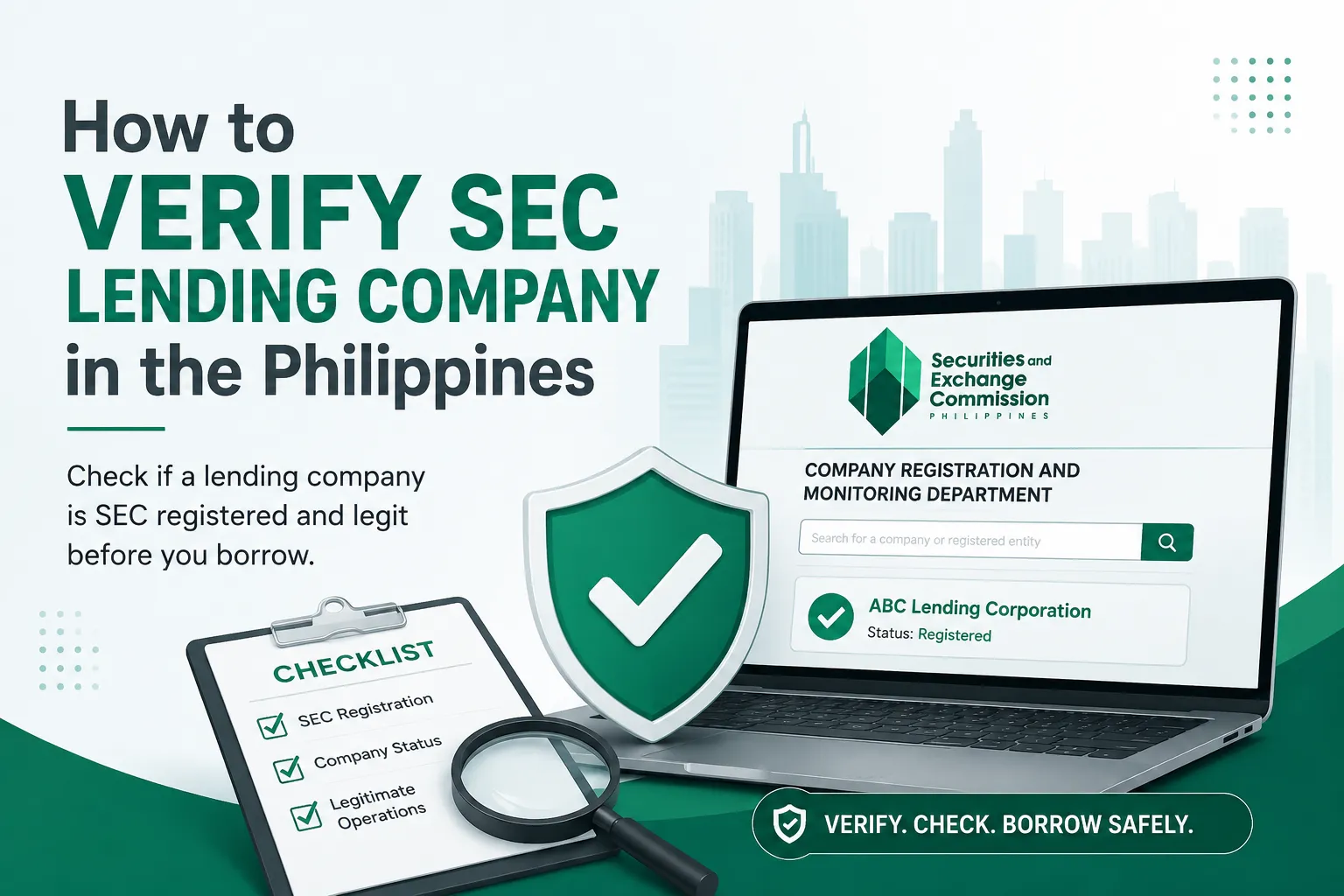
Before you send a single valid ID, bank detail, or selfie to any lender, one check matters more than all the others: confirm the company holds a valid SEC Certificate of Authority, not just an SEC registration. A business can be a real, registered corporation and still have no legal right to lend money to the public. That gap is exactly where most illegal and predatory lenders operate, and it is why "Is it SEC-registered?" is the wrong question to stop at.
What follows is the two-part check that separates legitimate lenders from the rest: how to run each check with the SEC's free tools, what the reopened online lending rules mean for borrowers, the interest and fees a legal lender can charge, and the red flags and rights to know before you borrow.
Key Takeaways
- SEC registration only proves a company exists. A Certificate of Authority proves it may legally operate as a lender. Verify the Certificate of Authority, not just the registration.
- Republic Act No. 9474 requires every lending company to hold a Certificate of Authority. Operating without one can mean fines, imprisonment, or both.
- You can verify any lender for free through the Check with SEC portal, the SEC Check App, or by texting SEC VERIFY [Company Name] to 2580.
- As of August 1, 2026, the SEC has reopened registration of new online lending platforms under MC No. 20, Series of 2026, with stricter rules. A lifted moratorium does not mean any app is automatically approved.
- Upfront fees before release of funds, demands for your full phone contact list, and 5-6 style rates are strong signals of an illegal lender.
Registered vs Authorized: The Two Checks That Matter
The most common mistake Filipino borrowers make is treating "SEC-registered" as proof of legitimacy. In Philippine practice there are two separate documents, and they answer two different questions.
A Certificate of Incorporation answers "Does this company legally exist?" It confirms the corporation is on the SEC's records. A Certificate of Authority answers the question that actually protects you: "May this company legally lend money to the public?" A corporation may appear in the SEC database and still not be authorized to lend.
The legal basis is Republic Act No. 9474, the Lending Company Regulation Act of 2007. Under this law, a lending company must be organized as a stock corporation, must carry a name that includes "Lending Company" or "Lending Investor," and cannot conduct business unless the SEC has granted it a Certificate of Authority. The law sets a minimum paid-up capital of 1,000,000 pesos for lending companies, though the SEC may require more. Operating without valid SEC authority may lead to fines, imprisonment, or both.
Financing companies sit under a different law, Republic Act No. 8556, the Financing Company Act. These corporations extend credit through direct lending, discounting or factoring receivables, or leasing. A financing company must be at least 40 percent Filipino-owned and must carry "financing company" or "finance company" in its name. Either way, the practical rule is the same: a legitimate lender or financier holds a live secondary license from the SEC, and you can confirm it in minutes.
How to Verify a Lending or Financing Company with the SEC
You do not need a lawyer or a paid service to run this check. The SEC provides several free verification channels, and a thorough check uses more than one. All of them lead to the same decision point: the status of the company's Certificate of Authority.
How do I check if a lending company is SEC registered?
Search the company's exact corporate name on the Check with SEC portal, using the registered corporate name rather than the app's marketing name, since these often differ. Text SEC VERIFY [Company Name] to 2580, a free service across major networks, and you will receive a reply confirming whether the company is registered and whether its lending authority is active. Then look specifically at the Certificate of Authority status under Lending Companies or Financing Companies, not just whether the name appears. A company that shows up as a registered corporation but has no Certificate of Authority, or whose authority is suspended or revoked, is not a lender you should transact with.
How do I verify an online lending app?
Online lending apps add one layer, because the app name, the developer name, and the corporate name are frequently three different things. Cross-check three things. Confirm the operating company holds a valid Certificate of Authority using the steps above. Confirm the specific platform appears on the SEC's list of recorded Online Lending Platforms, which the SEC publishes and updates. Then open the Developer section on the Google Play Store or Apple App Store and match that developer name against the registered corporate name. Some apps change their brand names while keeping the same corporate registration, so matching the store's developer field to the corporate name is the reliable check. If the app is not tied to a company with a live authority, or the platform is not among the SEC's recorded platforms, treat that as a stop sign regardless of how polished the app looks.
What do Active, Suspended, and Revoked mean?
The Certificate of Authority status is the heart of the check. The SEC has revoked the licenses of dozens of apps for harassment, illegal collection tactics, and data privacy violations, so a revoked status is not a technicality. It is the regulator telling you the lender broke the rules.
| Status | What It Means | What To Do |
|---|---|---|
| Active | Currently authorized to lend | Safe on this criterion, still check the rates and terms |
| Suspended | Authority temporarily pulled, often during investigation | Do not borrow |
| Revoked | Authority permanently cancelled, usually for violations | Avoid completely |
What Changed in 2026: The Reopened Online Lending Market
For nearly five years, the SEC froze the registration of new online lending platforms. That freeze has now ended, and it changes the landscape you are verifying within.
The SEC issued Memorandum Circular No. 20, Series of 2026, which lifts the moratorium on new Online Lending Platforms effective August 1, 2026, replacing the moratorium imposed under MC No. 10, Series of 2021. The circular was issued on July 7, 2026, and it strengthens consumer protection through tighter disclosure requirements, responsible lending practices, and closer oversight. It applies to all financing and lending companies that use apps or web-based systems to offer credit.
The critical point for a borrower is that reopening the door is not the same as blanket approval. Only financing and lending companies that meet the new requirements may operate borrower-facing platforms, and the SEC can refuse, suspend, or delist any platform that violates the guidelines. New apps will begin appearing, and some will be fully legitimate under the new framework. Your verification habit does not change. Confirm the Certificate of Authority, confirm the platform is recorded with the SEC, and match the developer name every time. Enforcement has stayed aggressive alongside the reopening, including a shutdown of seven unregistered lenders in August 2025 and a warning against 22 illegal lending apps in January 2026.
What a Legitimate Lender Can Legally Charge
Are 5-6 lenders legal in the Philippines?
No. The 5-6 scheme, where you borrow 5 and repay 6 over a short period, produces effective rates the Supreme Court has treated as usurious and illegal. The Usury Law's fixed ceilings were suspended by Central Bank Circular No. 905 back in 1982, but that did not make any rate acceptable. Courts still strike down interest that is unconscionable. Under Article 1409 of the Civil Code, stipulations imposing iniquitous or unconscionable interest are void from the beginning, cannot be ratified, and cannot be waived. When a court voids an excessive rate, the lender can still recover the principal, but a legal interest rate replaces the abusive one.
For regulated small consumer loans, there is now a hard cap. Under BSP Circular No. 1133, Series of 2021, implemented by SEC Memorandum Circular No. 3, Series of 2022 and extended by BSP Circular 1165, the ceilings below apply to covered loans, meaning unsecured, general-purpose loans that do not exceed 10,000 pesos with a tenor of up to four months.
| Charge | Legal Ceiling for Covered Loans |
|---|---|
| Nominal interest rate | 6% per month (about 0.2% per day) |
| Effective interest rate (all fees in) | 15% per month (about 0.5% per day) |
| Late-payment penalty | 5% per month on the amount due |
| Total cost of the loan | 100% of the amount borrowed |
The effective rate folds in the nominal interest plus processing, service, notarial, and similar fees, but excludes penalties for late payment. On top of the ceilings, RA 9474 requires every loan agreement to comply with the Truth in Lending Act (RA 3765) and the Consumer Act (RA 7394). A legitimate lender must disclose the real cost of borrowing in writing: the amount, the interest rate, every fee, the penalties, the schedule, and the total you will repay. A lender that hides the true cost, or buries fees that push the effective rate past the cap, is one to walk away from.
Red Flags of an Illegal or Predatory Lender
By the time a lending situation feels wrong, something usually is. These are the warning signs that most reliably separate scams and illegal operators from legitimate lenders.
Upfront fees before any money is released. Legitimate lenders deduct origination or processing fees from the loan proceeds after approval. They do not ask you to pay an insurance, processing, good-faith, or clearance fee before releasing funds. A demand for advance payment, especially through GCash to a personal number, gift cards, or remittance, is the single most common indicator of a loan scam.
Requests for your full contact list or bulk device permissions. Legitimate platforms may request some permissions, but bulk access to your entire contact list is a classic harassment tool used by illegal lenders. A solo personal loan has no legitimate need for every number in your phone.
No verifiable Certificate of Authority. If the operator is not on the SEC's records with a live authority, nothing else about the offer matters.
No real office, no working customer service, no company details in the app. Registered lenders are required to display their company information, so the absence of a clear company name, address, or customer service number is a warning sign.
High-pressure urgency. Rushing you to accept before you can read the terms is a manipulation tactic, not a courtesy. A legitimate lender expects you to review the disclosure. And if the numbers exceed the legal caps for a covered small loan, or the effective cost is deliberately obscured, the lender is operating outside the law.
Collection Harassment and Your Rights
Illegal lending and abusive collection almost always travel together, and Philippine rules draw a firm line here. SEC Memorandum Circular No. 18, Series of 2019 prohibits unfair debt collection practices by financing and lending companies. That includes threats or violence, obscene or profane language, false representations, contacting people in a borrower's phone who are not a co-maker or guarantor, and public shaming or disclosing a borrower's debt to third parties.
The Data Privacy Act (RA 10173) adds a second layer. An online lending app may not harvest and use your entire phone contact list. Any data collected must be limited to what is necessary for a declared, legitimate purpose, and a whole-contact-list upload for a single loan fails that test. Privacy violations fall under the jurisdiction of the National Privacy Commission.
One practical protection worth stating plainly: if a lender demands your ATM card as collateral, you should not surrender it. Keep possession of your card, and secure legal assistance if a lender pressures you to hand it over.
What To Do If You Already Borrowed or Were Harassed
If you have already engaged an unregistered lender or are facing harassment, act deliberately and keep records. Screenshot the app listing, the disclosures or lack of them, every message, and every collection contact, noting dates, times, names used, and amounts. That record is what makes a complaint actionable.
File a formal complaint against the lending or financing company with the SEC for investigation. The Commission acts on patterns, and complaints feed directly into the advisories, cease and desist orders, and license revocations that shut these operators down. If the lender accessed your contacts, shamed you, or disclosed your debt to others, file with the National Privacy Commission through its complaints mechanism.
The SEC's authority is regulatory. Where the conduct amounts to threats, extortion, or other acts that create criminal or civil liability, those belong before the regular courts, and you should secure a lawyer to protect your rights. If you shared bank or e-wallet credentials, contact your provider promptly to secure the account.
Frequently Asked Questions
Is an SEC-registered company automatically allowed to lend money?
No. SEC registration only confirms the corporation exists. To lend to the public, the company must also hold a valid Certificate of Authority under RA 9474. Always verify the Certificate of Authority, not just the registration.
How do I check if an online lending app is legal in the Philippines?
Confirm the operating company holds a live Certificate of Authority through the Check with SEC portal or by texting SEC VERIFY [Company Name] to 2580, confirm the platform appears on the SEC's list of recorded Online Lending Platforms, and match the developer name on the app store to the registered corporate name.
What is the maximum interest an online lender can charge?
For covered small consumer loans that are unsecured, general-purpose, up to 10,000 pesos, and with a tenor up to four months, BSP Circular 1133 caps the nominal rate at 6 percent per month and the effective rate at 15 percent per month, with late penalties capped at 5 percent per month and total cost capped at 100 percent of the amount borrowed.
Are 5-6 lenders legal?
No. The Supreme Court has treated 5-6 style rates as usurious and illegal. Courts void unconscionable interest from the start, though the lender can still recover the loan's principal under a legal interest rate.
Can a lending app legally access all my contacts?
No. SEC MC No. 18, Series of 2019 and the Data Privacy Act prohibit harvesting your full contact list and contacting people who are not co-makers or guarantors. This is a defining marker of an illegal or abusive lender.
Did the SEC really allow new online lending apps again in 2026?
Yes. Under MC No. 20, Series of 2026, the SEC lifted its nearly five-year moratorium on new online lending platforms effective August 1, 2026, under stricter disclosure and capital rules. Approval is not automatic, and the SEC can suspend or delist any platform that violates the guidelines.
Looking for verified providers?
Browse financial services businesses listed on azifind, and always confirm a lender's Certificate of Authority with the SEC before you commit. Run a business yourself? Add or claim your listing for free.