Household population meaning, in the context of Philippine statistics, refers to all persons who belong to a household as counted by the Philippine Statistics Authority (PSA). This is the formal definition used in every Census of Population and Housing conducted in the country, including the most recent 2024 Census of Population (2024 POPCEN). It is not interchangeable with total population, and the difference between the two figures is not a footnote. It is foundational to how the Philippine government allocates housing, school seats, health facilities, and local development budgets across 42,011 barangays.
To understand the term fully, you need to understand what a household is under PSA operational definitions, how it differs from an institutional living quarter, how the average household size is derived, and what the 2024 POPCEN data reveals about where Philippine household population is concentrated and how fast it is changing.
What Is Household Population? The Official PSA Definition
Household population comprises all persons who belong to a household. That is the PSA's complete formal definition, and its precision is intentional. It delegates all meaning to the definition of a household itself.
Under PSA census methodology, a household is a social unit consisting of either a person living alone, or a group of persons who sleep in the same housing unit and share a common arrangement in the preparation and consumption of food. Household population is therefore the count of every individual who meets that membership criterion across the entire country, tallied at the barangay level and aggregated upward to city, province, region, and national totals.
The 2024 POPCEN was conducted on a de jure basis. Every person was counted at their usual place of residence, defined as the geographic location where they normally sleep, which may or may not match where they were physically found on census day. For a country with significant internal migration and a large overseas workforce, this distinction matters considerably in determining who gets counted where.
"Household population is not interchangeable with total population. The distinction shapes how housing demand, school construction, and public service allocation are planned at every level of Philippine government."
Household Population vs. Institutional Population: The Critical Distinction
One of the most common errors in reading PSA census data is treating household population and total population as identical figures. The Philippine total population count includes both household population and institutional population, two categories the PSA counts and reports separately.
Institutional population comprises persons found living in Institutional Living Quarters (ILQs). An ILQ is a structurally separate and independent place of abode intended for large groups of individuals, typically with shared facilities including a kitchen, dining room, toilet, and bath. Persons confined, committed, or residing in these ILQs at the time of the census are classified as institutional population, not household population, even if they maintain a family or household elsewhere.
ILQ data in the 2024 POPCEN was sourced from several national agencies. The Department of Social Welfare and Development (DSWD) provided data on welfare institutions. The Bureau of Corrections (BuCor) and Bureau of Jail Management and Penology (BJMP) covered corrective and penal institutions. The Philippine National Police (PNP) covered custodial facilities. Each source was field-verified by Provincial Statistical Offices to ensure accuracy before inclusion in census totals.
This separation matters for urban planning, housing demand analysis, and local government unit resource allocation. Household population is the figure used to compute average household size and the number of households. It is the planning input for residential infrastructure. Institutional population is tracked separately because its service needs, facility requirements, and resource implications are fundamentally different from those of the general residential population.
Philippine Population in 2024: The Census Context
The 2024 Census of Population recorded a total Philippine population of 112,729,484 as of 01 July 2024. This count was declared official by the President of the Philippines through Proclamation No. 973 dated 11 July 2025, pursuant to Republic Act No. 10625, the Philippine Statistical Act of 2013.
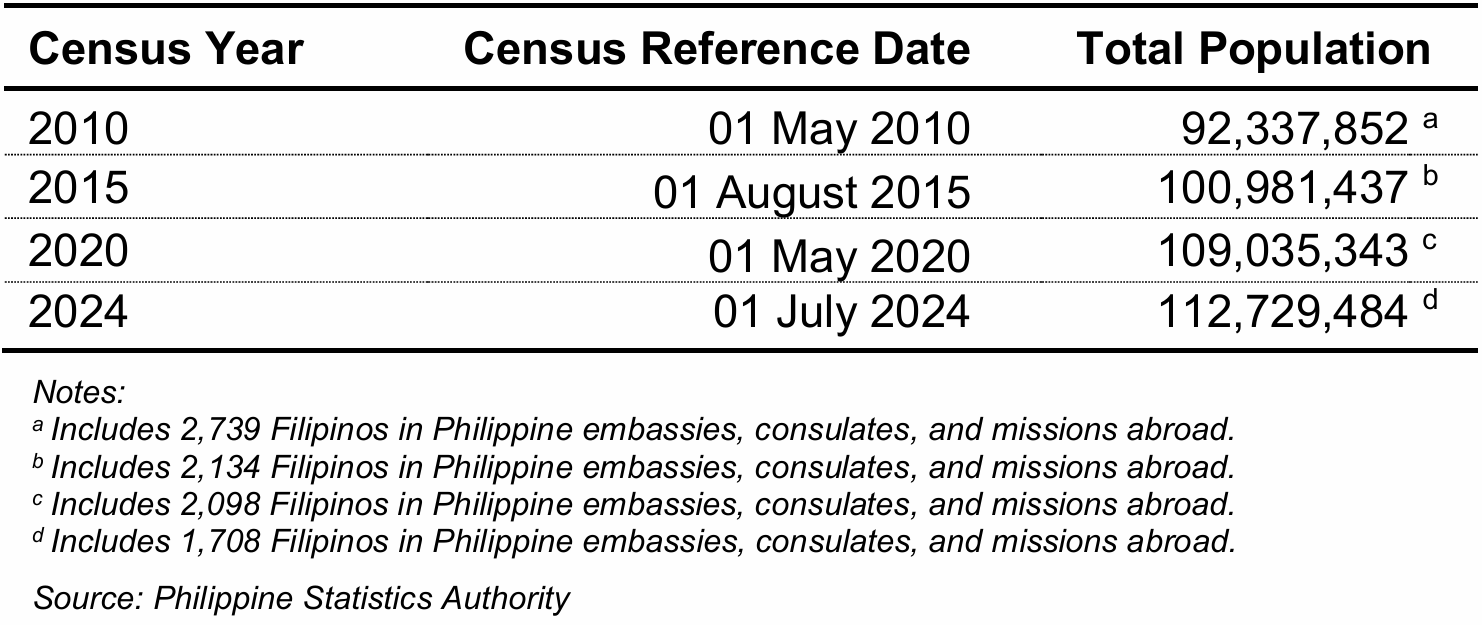
From 92.3 million in 2010, the count crossed 100 million in 2015, reached 109.0 million in 2020, and stands at 112.7 million in 2024. Each of these total population figures encompasses both household population and institutional population, which is why the two categories must be understood separately for planning and policy purposes.
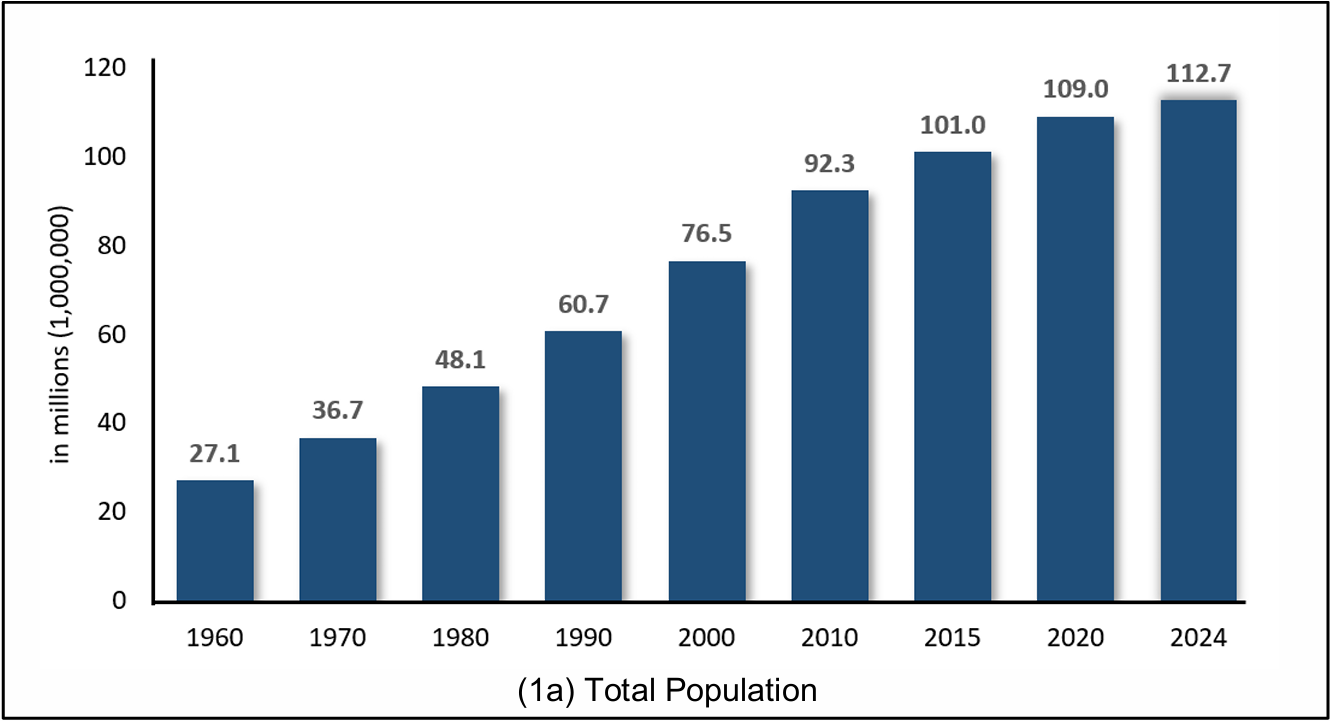
The long-run trajectory from 27.1 million in 1960 to 112.7 million in 2024 spans more than six decades of demographic expansion. For housing and household-level analysis, this growth directly informs how the number of households and the average household size have shifted over the same period.
A Slowing Growth Rate and What It Means for Household Planning
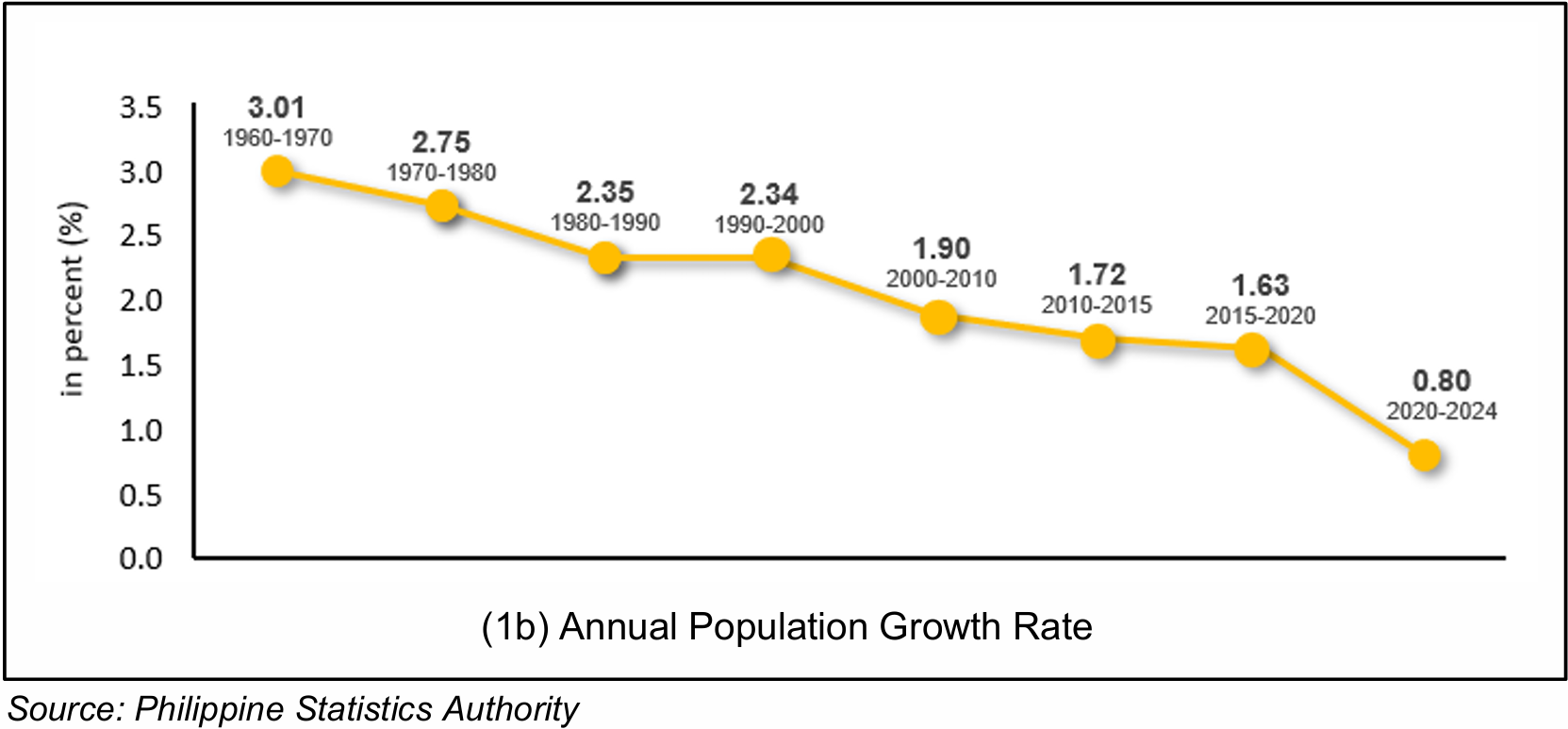
The annual population growth rate (PGR) has been on a consistent downward trend since its 1960-1970 peak of 3.01 percent. By the 2020-2024 intercensal period, the PGR fell sharply to 0.80 percent, less than half the 1.63 percent recorded for 2015-2020. The PSA attributes this slowdown to declining fertility and birth rates, elevated mortality during the COVID-19 pandemic, and subdued migration activity.
A slowing growth rate has direct implications for household population projections. As fertility declines, household formation patterns shift. More one-person and two-person households form as young adults delay marriage and family-building. This reduces average household size even as the total number of households continues to grow. In practical terms, a local government unit may need to plan for more housing units serving fewer people per unit, a structural shift that changes infrastructure cost estimates considerably.
How the PSA Determines Household Membership
Household membership under PSA census methodology is determined primarily by usual place of residence, the geographic location where a person normally resides and, as a rule, where they sleep most of the time. Several nuances govern edge cases that arise during enumeration.
Household helpers, boarders, and non-relatives are counted as household members provided they sleep in the same housing unit, share food preparation and consumption arrangements, and do not return to their own family at least once a week. A group of unrelated individuals sharing a rental unit with common food arrangements constitutes one household regardless of kinship ties. When two or more distinct family groups share a single housing unit but maintain separate food arrangements, each group is counted as a separate household. A person who shares a housing unit but cooks or eats separately is classified as a one-member household.
These granular rules exist to ensure that household population counts are precise and comparable across census years and across every level of geographic unit, from the barangay to the national total. The 2024 POPCEN enumeration covered 42,011 barangays based on the Philippine Standard Geographic Code (PSGC) list maintained by the Department of the Interior and Local Government (DILG) as of August 2025.
"A local government unit may need to plan for more housing units serving fewer people per unit. That is the structural shift a declining average household size creates."
Average Household Size: What It Measures and Why It Matters
Average household size (AHS) is directly derived from household population data. The PSA computes it by dividing total household population by the total number of households.
Formula
Average Household Size (AHS) = Household Population ÷ Number of Households
This figure is a primary indicator of housing density, family structure trends, and demographic change over time. A declining AHS typically signals urbanization, rising nuclear family formation, or an increase in one-person households. A rising AHS may indicate economic pressure driving extended family cohabitation, or a population growth rate outpacing housing supply in a given area.
For researchers, local government units, and anyone reading PSA statistical releases, AHS values vary significantly across regions, provinces, and urban versus rural municipalities. The household population figure for a given administrative unit, combined with its number of households, tells a story about residential density and household structure that raw population alone cannot convey.
Where Household Population Is Concentrated: Regional Data
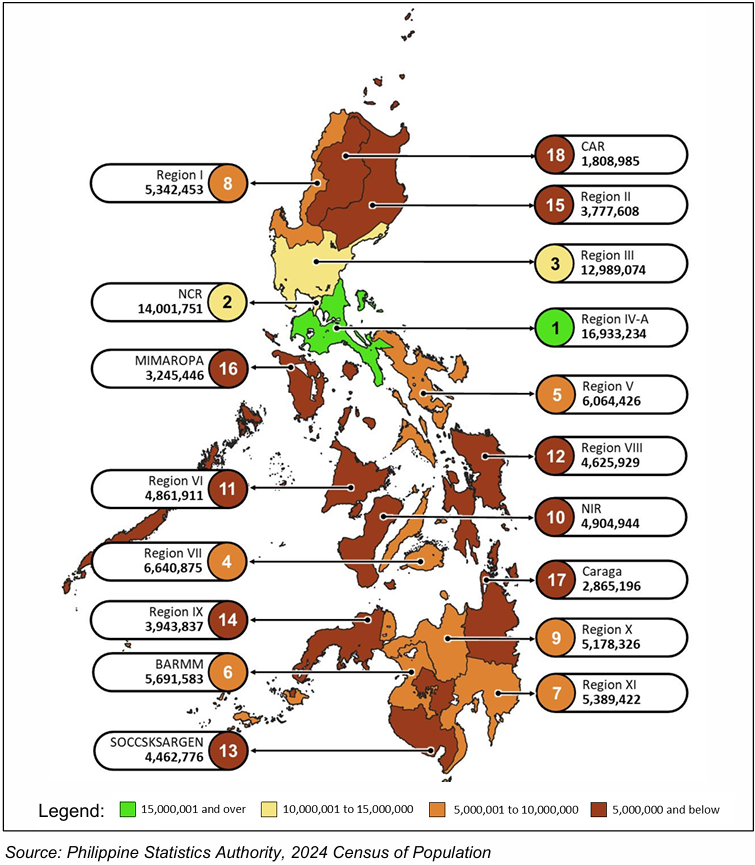
The 2024 POPCEN shows that household population is highly concentrated in Luzon. Region IV-A (CALABARZON) is the most populous region with 16,933,234 residents. The National Capital Region (NCR) follows with 14,001,751, and Region III (Central Luzon) ranks third at 12,989,074. Together, these three regions account for approximately 39 percent of the national total.
At the other end, the Cordillera Administrative Region (CAR) is the least populated at 1,808,985, or roughly 1.6 percent of the national count. Region V (Bicol) recorded a negative population growth rate of -0.07 percent for 2020-2024, making it the only region with a declining population in this census cycle.
For household population analysis, these regional figures are the baseline from which housing demand projections, school construction targets, and health facility distribution are computed. The household population count for a specific region, province, or city is not equivalent to the number of persons who need housing. It must be read alongside the number of households and the AHS to produce an accurate infrastructure demand estimate.
Regional Growth Rate Divergence and Household Planning Implications
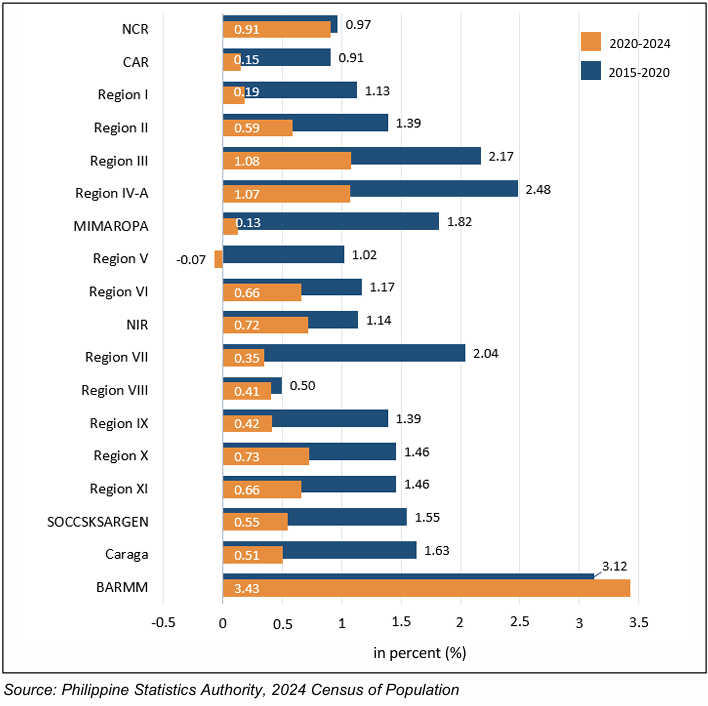
Sixteen of 18 regions experienced a slowdown in annual PGR between the 2015-2020 and 2020-2024 periods. The Bangsamoro Autonomous Region in Muslim Mindanao (BARMM) was the only region to post an increase, recording the highest national PGR at 3.43 percent for 2020-2024, up from 3.12 percent in 2015-2020. Region III (Central Luzon) and Region IV-A (CALABARZON) followed at 1.08 percent and 1.07 percent respectively.
For household population analysis, rapidly growing regions like BARMM require faster expansion of housing stock and public services. Slower-growing or declining regions like Bicol face a different planning challenge: the number of households may still rise even as overall population stagnates, because household size continues to shrink as family structures change. This is precisely why the PSA releases household population, number of households, and average household size as a combined statistical output rather than reporting total population alone.
Who Was Counted: Inclusion and Exclusion Rules
The 2024 POPCEN enumerated all living persons as of 12:01 a.m. on 01 July 2024. The PSA applied specific inclusion and exclusion rules to ensure that household population counts were consistent across all 42,011 barangays.
Persons Included in the Household Population Count
Filipino nationals permanently residing in the Philippines were included. Overseas Filipino workers expected to return within five years from their last departure date were counted at their usual place of residence. Filipino nationals temporarily abroad for vacation, study, or training and expected to return within one year were likewise included. Philippine government officials and diplomatic personnel assigned abroad, along with their families, were counted. Foreign nationals with usual residence in the Philippines who had stayed or were expected to stay for at least one year were also included.
Persons Excluded
Foreign ambassadors and diplomatic representatives and their families were excluded. Citizens of foreign countries living within embassy premises were not counted. Officials of international organizations subject to reassignment after their tour of duty were excluded, along with foreign nationals or visiting balikbayans expected to stay in the Philippines for less than one year from their arrival.
These rules are applied consistently across census years, which is what makes household population figures comparable between the 2020 CPH and the 2024 POPCEN and across earlier censuses dating back to 1903.
Why Household Population Data Is Foundational for Philippine Planning
The PSA collects and publishes household population data to support government planning at every administrative level, from barangay to national. Housing programs, school construction targets, health facility distribution, and infrastructure allocation all use household population counts as the base figure, not total population.
For researchers, journalists, and local government units, understanding the PSA definition of household population and how it differs from institutional population and total population is the starting point for reading any census-derived statistic correctly. A figure that looks like a regional total population may be a household population subtotal. A per-capita computation may or may not exclude institutional residents. Getting the denominator right is the difference between an accurate policy input and a misleading one.
All 2024 POPCEN press releases and statistical tables, including barangay-level Table C files for all 18 regions, are publicly available at the PSA website: psa.gov.ph/population-and-housing. The most recent household population release, covering the number of households and average household size from the 2024 POPCEN, was published on 23 June 2026.