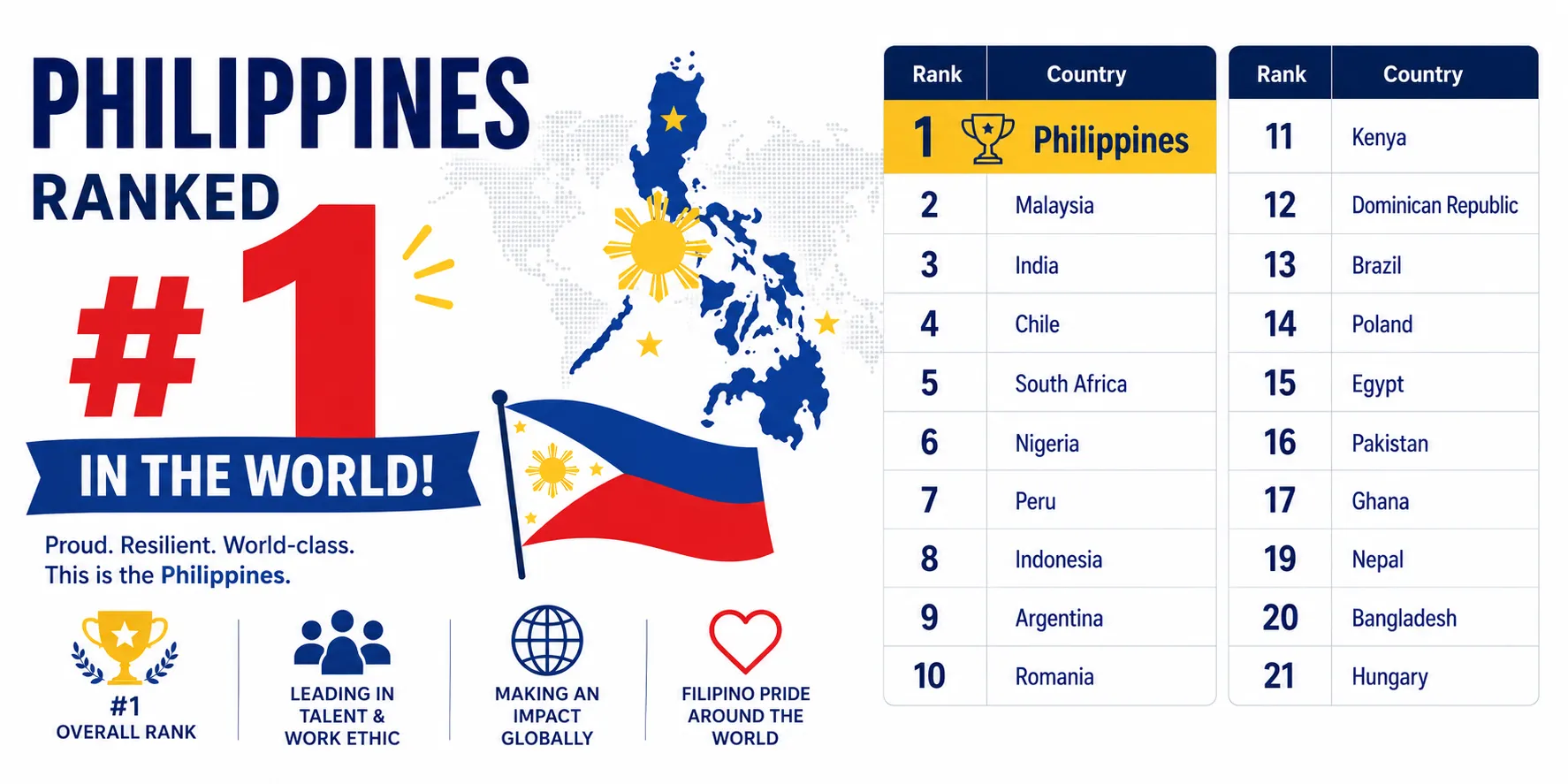
The Philippines ranked #1 globally on the 2026 Ataraxis Global Outsourcing Talent Index, ahead of Malaysia and India, on the strength of cost competitiveness, English proficiency, and workforce capability. The IT-BPM sector closed 2025 with 1.9 million workers and 40 billion dollars in export revenues, and it is on pace to reach 1.97 million employees and 42 billion dollars by the end of 2026.
That combination of scale, cost, and language readiness is why foreign companies keep choosing the Philippines over every other outsourcing market, even as India's total BPO market remains larger in raw dollar terms. Below is the data behind that position, category by category, along with the trade-offs worth weighing before signing with a provider.
The Philippine IT-BPM Industry, By the Numbers
Revenue has grown without a single year of net decline since the survey series began. The industry posted 1.3 billion dollars in 2004; by 2011 that had grown to 12.1 billion, and it closed 2025 at roughly 40 billion, with 42 billion projected for 2026.
#1
2026 Global Outsourcing
Talent Index Rank
$40B+
IT-BPM Export
Revenue, 2025
1.9M
Industry Workforce,
End of 2025
~8%
Share of
Philippine GDP
IT-BPM Export Revenue Growth, 2004–2026
*2026 figure is IBPAP's projected export revenue. Source: Bangko Sentral ng Pilipinas survey series (2004–2011), IBPAP (2016–2026).
IT-BPM Employment Growth, 2004–2028
*2028 figure is the IT-BPM Roadmap 2028 employment target. Source: Bangko Sentral ng Pilipinas survey series (2004–2011), IBPAP (2016–2028).
| Year | Revenue | Source |
|---|---|---|
| 2004 | $1.3B | BSP survey |
| 2011 | $12.1B | BSP survey |
| 2016 | $25B | IBPAP |
| 2024 | $38B | Industry reporting |
| 2025 | $40B (export revenue) | IBPAP |
| 2026 (projected) | $42B | IBPAP |
Employment has followed a similar curve: 94,488 workers in 2004, 679,464 in 2011, 1.4 million in 2016, and 1.9 million at the end of 2025, with a 2028 target of 2.5 million. IT-BPM's share of Philippine GDP climbed from 1.4 percent in 2004 to roughly 7.5 to 8.5 percent as of end-2025. Since the IT-BPM Roadmap launched in 2022, the industry has created 450,000 new jobs and 10.5 billion dollars in incremental revenue.
Where the Philippines Ranks in the 2026 Global Outsourcing Talent Index
Ataraxis' 2026 Global Outsourcing Talent Index scores each country from 0 to 100 on cost efficiency, English proficiency, and talent availability, using public datasets from LinkedIn, UNESCO, EF EPI, Gallup World Poll, ITU, Ookla, the World Bank, the World Economic Forum, and the Heritage Foundation. The Philippines finished first overall with a total score of 90.65, ahead of Malaysia in second and India in third.
Behind that score sits a specific data profile: over 7 million professionals searchable on LinkedIn, 1.45 million graduates entering the workforce annually from higher education and vocational programs combined, and a "High Proficiency" English ranking of 2nd in Asia and 28th globally. Digital infrastructure covers 73.6 percent of the population, or roughly 87 million people online, and the country's business risk level is rated moderate, reflecting manageable regulatory friction balanced against real considerations like typhoon season and provincial infrastructure variability.
Grouped into tiers, individual ranks, or flagged risk, the pattern is easier to act on. Use the tabs below to switch between views.
The top 20 places the Philippines ahead of Malaysia, India, Chile, and South Africa, with Nigeria, Peru, Indonesia, and Argentina rounding out the top ten.
| Rank | Country | Rank | Country |
|---|---|---|---|
| 1 | Philippines | 11 | Kenya |
| 2 | Malaysia | 12 | Dominican Republic |
| 3 | India | 13 | Brazil |
| 4 | Chile | 14 | Poland |
| 5 | South Africa | 15 | Egypt |
| 6 | Nigeria | 16 | Pakistan |
| 7 | Peru | 17 | Ghana |
| 8 | Indonesia | 19 | Nepal |
| 9 | Argentina | 20 | Bangladesh |
| 10 | Romania | 21 | Hungary |
Top-ranked countries, Ataraxis 2026 Global Outsourcing Talent Index. Rank 18 is a mid-volatility market that sits outside this top-20 view; see the Countries to Avoid tab.
Why Is the Philippines the Top BPO Destination?
The Philippines built its position on a specific combination of factors few competing markets replicate together: neutral, Western-facing English fluency, deep cultural alignment with US and Australian client bases, a large annual output of college graduates, and a government that has treated BPO as a named national priority since the mid-2000s. No single factor explains the ranking on its own. India offers a larger talent base and lower absolute wages in some cities, but the Philippines wins on voice-service quality and accent neutrality specifically, which is why its dominance is concentrated in customer-facing roles rather than the entire BPO category.
The 2026 Ataraxis Global Outsourcing Talent Index formalizes this into a single number, placing the Philippines first overall with a composite score of 90.65 out of 100, measured across cost efficiency, English proficiency, and talent availability. See the full ranking breakdown below for how that score compares to the rest of the top 20.
The Workforce and Cultural Fit
Filipino BPO staff communicate in a neutral, trainable American-influenced accent, which matters more to voice-service clients than raw fluency scores suggest. The country's population exceeds 112 million, with 2.16 million Overseas Filipino Workers sending home over 38 billion dollars annually in remittances, a flow that has normalized working for international employers as a mainstream career path rather than an exception. Ataraxis puts the current annual output at 1.45 million graduates from higher education and vocational programs combined, feeding a pipeline that spans accounting, engineering, health care, IT, and finance rather than customer service alone, and backing a searchable talent pool of over 7 million professionals on LinkedIn. That talent pool is also why the country consistently places well in workplace-quality rankings; see our comparison of the two major "best companies to work for" rankings in the Philippines.
English Proficiency, With a Caveat Worth Naming
Ataraxis' 2026 index, which blends UNESCO, TOEFL, and EF EPI data with expert interpretation, ranks the Philippines 2nd in Asia and 28th globally for English proficiency, placing it in the "High Proficiency" band. Separate EF EPI-only rankings have placed the country closer to 22nd globally in some recent years; the two figures move slightly depending on methodology and survey year, but both agree the Philippines sits comfortably in the upper tier worldwide and near the top of Asia specifically. The caveat worth naming: the education system carries real strain, with a 1:40 teacher-student ratio against an ideal of 1:30, an estimated 86,000 teacher shortage, and a 91,000 classroom deficit nationwide. Companies hiring at scale should budget for onboarding and continuous training rather than assuming every hire arrives interview-ready.
Is the Philippines the BPO Capital of the World?
The Philippines holds the title specifically in voice services, not across every BPO category. Everest Research first confirmed the Philippines overtook India as the world's number-one voice services center in January 2011, at 5.7 billion dollars in revenue against India's 5.5 billion. By 2010, IBM's Global Locations Trend ranked the Philippines number one worldwide in the shared services and BPO categories combined.
Today the country holds roughly 36 percent market share in offshore English-language contact center outsourcing, even though India's overall BPO market, which includes IT services and back-office work at far greater scale, remains larger in total dollar value. The distinction matters for anyone framing this competitively: the Philippines leads on voice, India leads on volume. Cebu has emerged as the country's clearest secondary hub for this growth; see our Cebu business landscape guide for how its IT-BPM footprint compares to Metro Manila's.
What Percentage of the Philippine Economy Is BPO?
IT-BPM contributed an estimated 7.5 to 8.5 percent of Philippine GDP as of the end of 2025, up from 5.4 percent in 2011 and just 1.4 percent in 2004, based on Bangko Sentral ng Pilipinas survey data spanning that period. Export earnings tell a similar story: the industry's exports accounted for 17.4 percent of the country's total exports of goods and services in 2011, up from 2.1 percent in 2004, and IT-BPO services receipts, alongside overseas Filipino remittances, are cited by BSP as the structural driver behind the country's balance-of-payments surplus since 2005.
Is Call Center Work Still in Demand in the Philippines?
Yes. Contact centers remain the largest single subsector by both revenue and employment share, and the underlying demand has not slowed. The sector added roughly 80,000 net new jobs in 2025 and 135,000 in 2024, even as AI adoption spread across the industry. Contact centers accounted for 63.8 percent of total IT-BPO employment as of the most recent BSP survey year, a share that has held above 55 percent for over a decade.
Demand persists because voice work, particularly complex escalations that automated systems cannot resolve, still requires human judgment, and Western companies continue outsourcing that function rather than insourcing it. For a location-by-location breakdown of where this demand actually concentrates, see our guides to the best BPO and call center hubs in Metro Manila and the best BPO and call center hubs outside Metro Manila.
Why Do Many Companies Still Prefer Domestic BPO?
Companies that keep BPO functions domestic typically cite four reasons: tighter regulatory and compliance control, particularly in health care and financial services where data sovereignty rules apply; faster escalation paths without time zone lag; direct cultural and linguistic alignment for hyper-local customer bases; and reduced exposure to geopolitical or currency risk. These are legitimate trade-offs. The decision to outsource offshore versus keep operations domestic usually comes down to whether the cost savings and talent access outweigh the loss of direct oversight, and for highly regulated or highly localized functions, many companies conclude they do not.
Why Do Filipinos Go Into the Call Center Industry?
BPO roles pay above the average for entry-level local work, and English fluency functions as a directly marketable skill rather than a bonus qualification. TESDA-run contact center training programs, in partnership with the Department of Information and Communications Technology, give aspiring agents structured pathways into the industry, covering grammar, accent training, and customer service technique. For many workers, particularly those supporting extended families, a BPO job offers faster income stability than waiting for openings in their formal degree field. For a full breakdown of how that pay stacks up against everyday costs, see Philippine wages vs. cost of living in 2026.
Will AI Replace BPO in the Philippines?
The current data points to augmentation rather than replacement. The industry added 135,000 jobs in 2024 despite 67 percent of BPO companies having already implemented AI technologies that year. Filipino BPO workers are shifting from basic call handling toward managing AI tool output, analyzing escalations AI systems cannot resolve, and handling higher-complexity customer interactions.
IBPAP reports that only 12 percent of Philippine companies currently show high AI maturity, with 70 percent expected to reach that level by 2028, a transition backed by a 25 million dollar annual upskilling commitment and the 740 million peso Project UNLAD initiative run jointly with DICT and TESDA. Revenue growth of roughly 7 percent alongside employment growth of 4 to 5 percent suggests companies are moving up the value chain rather than racing toward pure cost-cutting through automation.
Why Is BPO the Fastest Growing Industry in the Philippines?
Structural advantages, English proficiency, Western cultural alignment, a large young graduate workforce, and government support through PEZA and IBPAP have combined with significantly lower labor costs relative to the US, UK, and Australia. The sector grew at an average annual expansion rate of 20 percent between 2004 and 2011 according to BSP survey data, and while growth has moderated as the base has scaled into the billions, the Philippine BPO sector still grew 5 to 7 percent in 2025 against a global outsourcing average of roughly 3 to 3.5 percent, depending on the source cited. That outperformance, sustained across two decades, is what distinguishes fast growth from a temporary boom.
Which Is Better: BPO or BPM?
The two terms describe different layers of the same discipline. Business Process Management, or BPM, is the broader practice of designing, monitoring, and continuously improving an organization's internal workflows. Business Process Outsourcing, or BPO, is one execution method within that discipline: handing a defined process to a third-party provider rather than running it in-house. Neither is categorically superior. A company can practice strong BPM entirely with internal staff, or it can use BPO as one tool inside a broader BPM strategy. The right choice depends on whether the process in question benefits more from direct internal control or from a specialized external provider's cost structure and scale.
What Are the Disadvantages and Problems With BPO in the Philippines?
The most consistently documented problems across industry sources are workforce turnover, which can reach up to 50 percent annually in some segments; physical strain including back and shoulder pain from workstation setups, throat irritation from high call volume, and hearing concerns tied to prolonged audio exposure; psychosocial stress from irregular, night-shift schedules that disrupt family and social life in a culture that places high value on family closeness; and a widening education gap, with learning poverty affecting 91 percent of 10-year-olds nationally.
The same 86,000 teacher shortage and 91,000 classroom deficit that strain general education also constrain the supply of graduates ready for higher-value BPO roles without additional employer-funded training. Wage pressure is rising as the sector competes harder for skilled workers in growing categories like AI operations and data science, where postings grew 163 percent year over year in 2025. And as the industry moves further up the value chain, compliance requirements around data privacy, labor law, and intellectual property protection have become more complex for providers to manage at scale.
Is call center work hard in the Philippines? Physically and psychologically, yes, for a meaningful share of the workforce. These are not edge cases; they appear consistently across academic case studies on the sector's working conditions, which is part of why agent retention remains one of the industry's persistent operational challenges. Businesses evaluating a Philippine BPO partner should budget for structured onboarding and treat agent retention as an active cost line rather than an assumed constant.
Who Brought BPO to the Philippines?
Frank Holz is generally credited with establishing the country's first contact center, the Accenture Global Resource Center, which began operations in 1992. On the policy side, Mar Roxas is popularly referred to as the "father of BPO" for lobbying Republic Act 7916 while at the Department of Trade and Industry in the late 1990s, legislation that allowed buildings to register as economic zones and directly enabled the industry's early expansion.
That title has been publicly contested by other industry figures, including former Aegis People Support Philippines president Rainiero Borja, who has said the framing originated more from conference introductions than from a formal industry designation. Other names credited with early contributions include former President Fidel V. Ramos, Myrna Padilla, and eTelecare co-founders Jim Franke and Derek Holley, who launched what is considered the first Filipino-founded call center in 1999. No single individual holds a widely agreed "mother of BPO" title the way the "father" title is informally attached to Roxas; readers should treat both as industry-circulated framings rather than official designations.
What Is the Highest Paying BPO Sector in the Philippines?
Software development has been the highest-paying IT-BPO subsector every year on record, averaging 15,313 dollars in annual compensation per employee in 2011 against 8,240 dollars for contact centers and 7,070 dollars for other BPO categories, based on BSP's longitudinal compensation survey. That gap reflects the broader shift up the value chain: as more of the industry moves into financial analytics, AI operations, and specialized technical services, average compensation across the sector overall has continued rising, from 4,989 dollars per employee in 2004 to 8,464 dollars by 2011, with the trend continuing as headcount grows in higher-skill categories. For current, company-by-company pay comparisons, see our guide to high-paying BPO and call center companies hiring in Metro Manila.
What Is the Biggest BPO Company in the Philippines?
Accenture holds the largest headcount in the country, with over 50,000 employees nationwide across offices in Manila, Cebu, and other hubs, and has operated continuously since 1985. Teleperformance and Concentrix are typically named alongside Accenture as the three largest players by scale and revenue. Below that tier, the market includes 750-plus smaller providers, giving foreign companies a genuine range of options from enterprise-scale partners to boutique specialists focused on a single vertical. Browse verified BPO and call center listings on azifind.com to compare providers directly.
One Last Thing
No single statistic explains why the Philippines holds the top spot. It's the combination: a talent pool that keeps growing, English fluency treated as national infrastructure rather than an accident, government incentives that have outlasted four presidential administrations, and an industry that has kept moving up the value chain instead of standing still while AI reshapes the work. Companies evaluating outsourcing partners should weigh all of that against the real trade-offs, turnover, training investment, and shift-work strain, rather than the headline numbers alone.
Once you've weighed the trade-offs, browse verified business listings on azifind.com to compare providers directly.
Frequently Asked Questions
Why is the Philippines the top BPO destination?
A combination of neutral English proficiency, Western cultural alignment, a large annual graduate pool, and consistent government tax incentives through PEZA and BOI, layered on top of significant cost savings versus US, UK, and Australian labor rates.
Is the Philippines the BPO capital of the world?
Specifically in voice services, yes, since 2010 to 2011. India's total BPO market remains larger by overall dollar value.
What percentage of the Philippine economy is BPO?
Roughly 7.5 to 8.5 percent of GDP as of end-2025.
Will AI replace BPO jobs in the Philippines?
Current data shows augmentation rather than replacement, with the industry adding jobs even as AI adoption expands, though the mix of roles is shifting toward AI-assisted and escalation-handling work.
What is the highest paying BPO sector?
Software development, which has led every other IT-BPO subsector in average annual compensation since 2004.
Who is credited with bringing BPO to the Philippines?
Frank Holz for establishing the first contact center in 1992, and Mar Roxas for the policy work that enabled the industry's early expansion, though the "father of BPO" title attached to Roxas has been publicly contested.
Is your business listed on azifind?
Claim your existing listing to update contact details, add a logo, and respond to reviews, or add your business if it isn't on azifind yet. Both are free.