Key Takeaways
- NCR minimum wage rises from ₱695 ($11.28) to ₱755 ($12.26) a day on July 25, 2026, then ₱780 ($12.66) by January 2027, under Wage Order No. NCR-27.
- Entry-level BPO and call center pay (₱15,000 to ₱28,000, about $243 to $455) sits close to the local minimum wage, not far above it.
- On a monthly USD basis, NCR minimum wage (roughly $319) is mid-pack among Southeast Asian outsourcing hubs, above Vietnam and most of Indonesia, roughly on par with Thailand, and far below the US and UK.
- June 2026 headline inflation was 6.4 percent nationally, with housing and utilities up 8.0 percent and transport up 12.8 percent year-on-year, eating into wage gains almost as fast as they land.
- OFW remittances hit a record $35.634 billion in 2025, a direct result of Filipino workers earning multiples of the local wage floor once they cross the wage gap shown in the global comparison.
- A growing share of Filipinos are closing that same gap without leaving the country, through content creation, virtual assistant work, freelancing, and online selling.
A day's minimum wage in Metro Manila now buys a specific, countable basket of groceries, and a specific number of US dollars once converted. This guide walks through that whole picture in order: first what Filipino workers actually earn, in minimum wage and in BPO pay specifically, then how that pay compares to Vietnam, Indonesia, Thailand, the US, and the UK, then how far it's already been eaten into by 2026 inflation before it even reaches a grocery basket, and finally the routes a growing number of Filipinos are taking to close that gap themselves, whether that's working abroad or building income at home through content creation, virtual assistant work, freelancing, or online selling.
Minimum Wage vs. Average Pay: NCR and the Regions
Two different numbers get used interchangeably in conversations about Filipino wages, and they measure completely different things. One is the legal minimum wage floor, set by regional wage boards. The other is PSA's average wage rate across all formal-sector workers, a market statistic that includes everyone from minimum-wage earners to senior specialists, not a wage floor at all. Both matter, but conflating them makes the gap between them look like an error instead of what it actually is.
The Legal Minimum Wage Floor
The Philippines has no single national minimum wage. Seventeen Regional Tripartite Wages and Productivity Boards set rates independently, and Metro Manila consistently sets the ceiling. Under Wage Order No. NCR-27, approved June 23, 2026, the daily minimum increases in two tranches to cushion the impact of fuel-driven inflation.
| Sector | Current | 1st Tranche (Jul 25, 2026) | 2nd Tranche (Jan 20, 2027) |
|---|---|---|---|
| Non-Agriculture | ₱695 $11.28 |
₱755 $12.26 |
₱780 $12.66 |
| Agriculture / Small Retail (≤15 workers) / Small Manufacturing (<10 workers) | ₱658 $10.68 |
₱718 $11.66 |
₱743 $12.06 |
| Domestic Workers (Kasambahay), NCR | ₱7,800 / month ($126.62) (effective February 2026) | ||
Average Pay Across All Formal-Sector Workers
This next table is a different statistic entirely: PSA's 2024 Occupational Wages Survey average monthly wage rate (basic pay plus regular cash allowances) for time-rated, full-time workers in formal establishments with 10 or more employees, covering all pay levels in that workforce, not just minimum-wage earners. It will run higher than the wage floor above in every region, because it's averaging in supervisors, specialists, and senior staff alongside entry-level workers. The full 17-region breakdown, taken directly from PSA's official statistical tables, looks like this:
| Region | Avg. Monthly Wage Rate (PSA) | USD Equivalent |
|---|---|---|
| Philippines (National Average) | ₱21,544 | $349.74 |
| National Capital Region (highest) | ₱29,310 | $475.81 |
| Central Visayas | ₱19,084 | $309.80 |
| CALABARZON | ₱19,711 | $319.99 |
| Davao Region | ₱17,953 | $291.44 |
| Cordillera Administrative Region | ₱17,432 | $282.99 |
| Central Luzon | ₱18,274 | $296.66 |
| Western Visayas | ₱16,104 | $261.43 |
| Cagayan Valley | ₱15,153 | $246.05 |
| Northern Mindanao | ₱14,519 | $235.70 |
| Ilocos Region | ₱14,780 | $239.93 |
| MIMAROPA | ₱14,238 | $231.14 |
| Caraga | ₱14,219 | $230.83 |
| Eastern Visayas | ₱13,467 | $218.62 |
| Bicol Region | ₱13,751 | $223.24 |
| SOCCSKSARGEN | ₱13,138 | $213.28 |
| Zamboanga Peninsula | ₱12,220 | $198.38 |
| BARMM (lowest) | ₱11,495 | $186.60 |
The gap between NCR and BARMM here, roughly ₱17,815 ($289.21) a month, is nearly three times BARMM's own average, and it exists entirely within this one PSA statistic. It is not a comparison between minimum wage and average pay, both columns are averages, the difference is purely regional. CALABARZON and Central Visayas, the two regions with the deepest BPO and manufacturing presence outside NCR, sit in the middle of that range rather than close to the top.
Source: Philippine Statistics Authority, 2024 Occupational Wages Survey, Table 2 (Average Monthly Basic Pay, Allowance, and Wage Rates of Time-Rated Workers on Full-Time Basis by Region, August 2024), establishments employing 10 or more workers. USD conversion at approximately ₱61.60 = $1, mid-July 2026. Exchange rates fluctuate; treat USD figures as directional, not exact.
Basic Pay in Call Centers and BPO
PSA's press release only names the highest- and lowest-paying industries. Its underlying statistical tables, however, publish the full breakdown for all 18 major industry groups. Here is the complete picture, sorted highest to lowest:
| Industry | Avg. Monthly Wage Rate | USD |
|---|---|---|
| Information and Communications (highest) | ₱43,676 | $709.02 |
| Professional, Scientific, and Technical Activities | ₱36,096 | $585.98 |
| Electricity, Gas, Steam & Air Conditioning Supply | ₱35,188 | $571.24 |
| Financial and Insurance Activities | ₱31,333 | $508.65 |
| Administrative and Support Service Activities (BPO / call centers) | ₱25,227 | $409.53 |
| Real Estate Activities | ₱25,007 | $405.96 |
| Arts, Entertainment, and Recreation | ₱24,531 | $398.23 |
| National Average, All Industries | ₱21,544 | $349.74 |
| Water Supply; Sewerage, Waste Management and Remediation | ₱21,543 | $349.72 |
| Transportation and Storage | ₱20,531 | $333.30 |
| Mining and Quarrying | ₱20,382 | $330.88 |
| Human Health and Social Work Activities (excl. public) | ₱20,351 | $330.38 |
| Manufacturing | ₱19,044 | $309.15 |
| Education (excl. Public Education) | ₱18,688 | $303.37 |
| Construction | ₱17,358 | $281.79 |
| Wholesale and Retail Trade; Vehicle Repair | ₱17,200 | $279.22 |
| Other Service Activities (excl. Membership Orgs.) | ₱15,730 | $255.35 |
| Accommodation and Food Service Activities | ₱15,256 | $247.67 |
| Agriculture, Forestry, and Fishing (lowest) | ₱14,615 | $237.25 |
Source: Philippine Statistics Authority, 2024 Occupational Wages Survey, Table 1 (Average Monthly Basic Pay, Allowance, and Wage Rates of Time-Rated Workers on Full-Time Basis by Major Industry Group, August 2024), establishments employing 10 or more workers. All 18 industry groups PSA tracks are shown; this is the complete breakdown, not a partial excerpt.
Important distinction: “Information and Communications” at the top of this table is PSA's category for software publishing, telecom, and IT services, it is not the same industry classification as voice-based call centers and customer service BPO operations. Those fall under “Administrative and Support Service Activities,” highlighted above, which PSA's official Table 1 puts at ₱25,227 ($409.53) a month, the actual industry-wide figure for the sector, not a proxy. The ₱43,676 figure at the top of the table is best read as what software developers, telecom staff, and IT services professionals earn on average, not what a typical call center or BPO worker takes home.
Actual frontline BPO and call center pay, sourced from industry-specific salary aggregators rather than PSA's broader industry classification, looks like this instead:
| Level | Monthly Pay (PHP) | USD Equivalent |
|---|---|---|
| Entry-Level Agent | ₱15,000 – ₱28,000 | $243 – $455 |
| Mid-Level / Specialist | ₱25,000 – ₱45,000 | $406 – $731 |
| Team Lead / Supervisor | ₱40,000 – ₱120,000+ | $649 – $1,948+ |
This is why the two tables don't match, and shouldn't be expected to: the industry-classification figures above describe software and telecom professionals, while the agent-level figures describe the frontline BPO workforce most people mean when they say “call center job.” Both are accurate for what they measure, they just measure different things.
See a full company-by-company breakdown in our guide to high-paying BPO and call center companies hiring in Metro Manila.
Inflation Is Eating the Wage Gains Before They Land
The wage increases covered above don't happen in a vacuum. The June 2026 Consumer Price Index report from PSA shows why the ₱85 ($1.38) minimum wage bump was structured the way it was, and why labor groups are already calling it insufficient.
Headline Numbers
Philippine headline inflation hit 6.4 percent year-on-year in June 2026, easing slightly from 6.8 percent in May but still well above the 1.4 percent recorded in June 2025. Core inflation, which strips out volatile food and energy prices, actually moved the opposite direction, climbing to 4.4 percent from 4.1 percent the month before, a sign that price pressure is broadening beyond just fuel and food. Year-to-date average inflation for the first half of 2026 sits at 4.8 percent.
The biggest driver was transport, up 12.8 percent year-on-year, tied directly to the fuel price shocks from the Middle East conflict referenced in the wage order's own justification. Housing, water, electricity, and gas followed close behind at an 8.0 percent annual increase nationally. Food inflation eased slightly to 5.4 percent, still elevated, with rice up 15.0 percent year-on-year and vegetables up 9.0 percent.
The Regional Split Mirrors the Wage Split
Just as minimum wage and average pay vary sharply by region, so does inflation, and not always in the direction that helps workers outside Metro Manila.
| Area | June 2026 Inflation |
|---|---|
| Philippines (National) | 6.4% |
| NCR | 4.9% |
| Areas Outside NCR | 6.7% |
| Central Visayas (highest) | 10.0% |
| Caraga | 8.9% |
| BARMM | 8.0% |
| CALABARZON | 6.3% |
NCR posted the mildest headline inflation at 4.9 percent in June, while Areas Outside NCR ran hotter at 6.7 percent. Within that group the spread is wide: Central Visayas posted the highest regional inflation in the country at 10.0 percent, followed by Caraga at 8.9 percent and BARMM at 8.0 percent. CALABARZON, right next door to Metro Manila and home to a large share of outsourced and manufacturing labor, ran at 6.3 percent. This matters because it's the same regions with the lowest wages, BARMM has both the lowest average pay in the country and 8.0 percent inflation, that are also seeing some of the sharpest erosion in what their pesos actually buy.
Why the Wage Order Was Split Into Two Tranches
Wage Order No. NCR-27 explicitly cites this inflationary pressure as the reason the ₱85 ($1.38) daily increase was staggered into a ₱60 ($0.97) tranche now and a ₱25 ($0.41) tranche in January 2027, rather than delivered all at once. The board's own language points to “the decline in the value of real wages” and the need to align the adjustment with the inflation-adjusted poverty threshold.
But labor groups aren't convinced the increase keeps pace. Labor coalition Unity for Wage Increase Now (UWIN) filed an appeal with the National Wages and Productivity Commission against the ₱85 ($1.38) increase, arguing it falls short given current inflation. UWIN spokesman Allan Labahata put it bluntly: the increase is not enough to cover high electric bills on top of food, tuition, and everyday expenses, and the group is pushing for a ₱505 ($8.20) increase instead. That pushback lines up with the math: a ₱60 ($0.97) first-tranche raise against 6.4 percent national inflation and 4.9 percent NCR inflation is a real gain, but a modest one, and it's already partly offset by the same fuel and transport costs the wage order was designed to cushion against.
The DTI Side of the Same Story
The Department of Trade and Industry has been negotiating directly with manufacturers to delay price increases on basic goods, an unusual intervention that underscores how tight the margin is. As of May 2026, DTI reported that 68 percent of monitored products had held prices steady, with adjustments limited mostly to select brands like canned sardines and processed milk rather than entire categories, largely because fishing and freight operations are absorbing the same elevated fuel costs driving transport inflation. That's a temporary buffer, not a fix, and it illustrates how close to the edge basic-goods pricing is running even before the second wage tranche lands.
What This Means for the Wage-vs-Cost-of-Living Gap
Add inflation to the earlier picture and the gap between what workers earn and what they need doesn't just persist, it moves. A ₱695-to-₱755 ($11.28 to $12.26) daily minimum wage increase looks meaningful in isolation. Measured against 6.4 percent national inflation and an 8.0 percent jump in housing, water, and electricity costs, a meaningful share of that increase is already spoken for before a worker sees a bigger grocery basket or a lighter transport bill. For outsourcing clients abroad, this dynamic is largely invisible, since USD-denominated pay isn't directly exposed to peso inflation, but it's a live factor in why local minimum wage keeps needing revision, and why the “cheap labor” framing understates how much ground Filipino workers are actually running just to hold in place.
What Minimum Wage Actually Buys at the Grocery
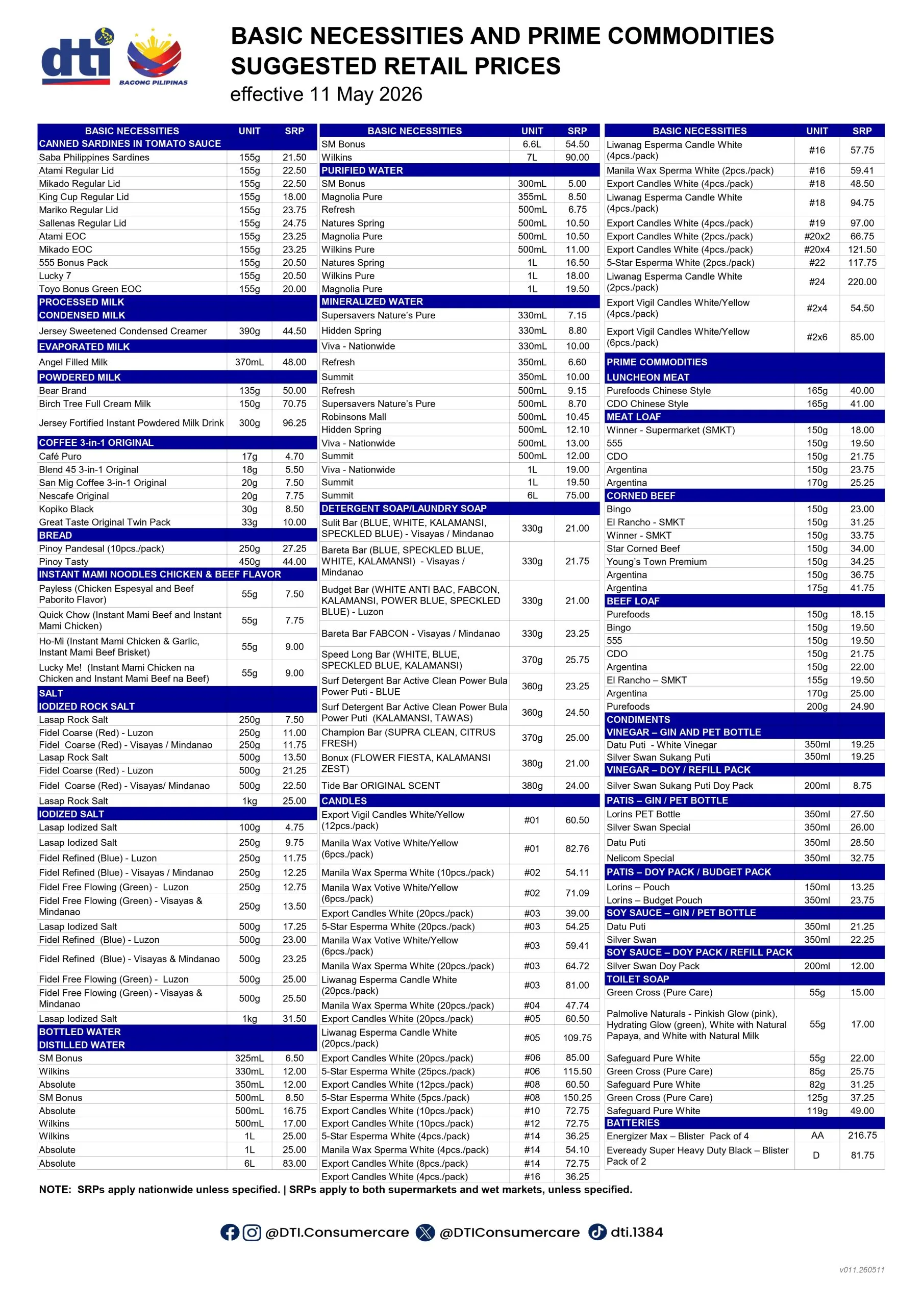
DTI's suggested retail price list for basic necessities and prime commodities, effective May 11, 2026, puts a concrete face on the inflation and wage numbers already covered. Instead of abstract percentages, here is what a single day's minimum wage translates to at the sari-sari store or supermarket.
A Sample Daily Basket
Using DTI's suggested retail prices, a basic one-day grocery run for a small household might look like this:
| Item | Unit | SRP | USD |
|---|---|---|---|
| Pinoy Pandesal | 10 pcs / 250g | ₱27.25 | $0.44 |
| Canned Sardines (Saba) | 155g | ₱21.50 | $0.35 |
| Instant Noodles (Lucky Me!) | 55g | ₱9.00 | $0.15 |
| Coffee 3-in-1 (Kopiko Black) | 30g | ₱8.50 | $0.14 |
| Detergent Bar (Sulit Bar) | 330g | ₱21.00 | $0.34 |
| Toilet Soap (Green Cross) | 55g | ₱15.00 | $0.24 |
| Corned Beef (Bingo) | 150g | ₱23.00 | $0.37 |
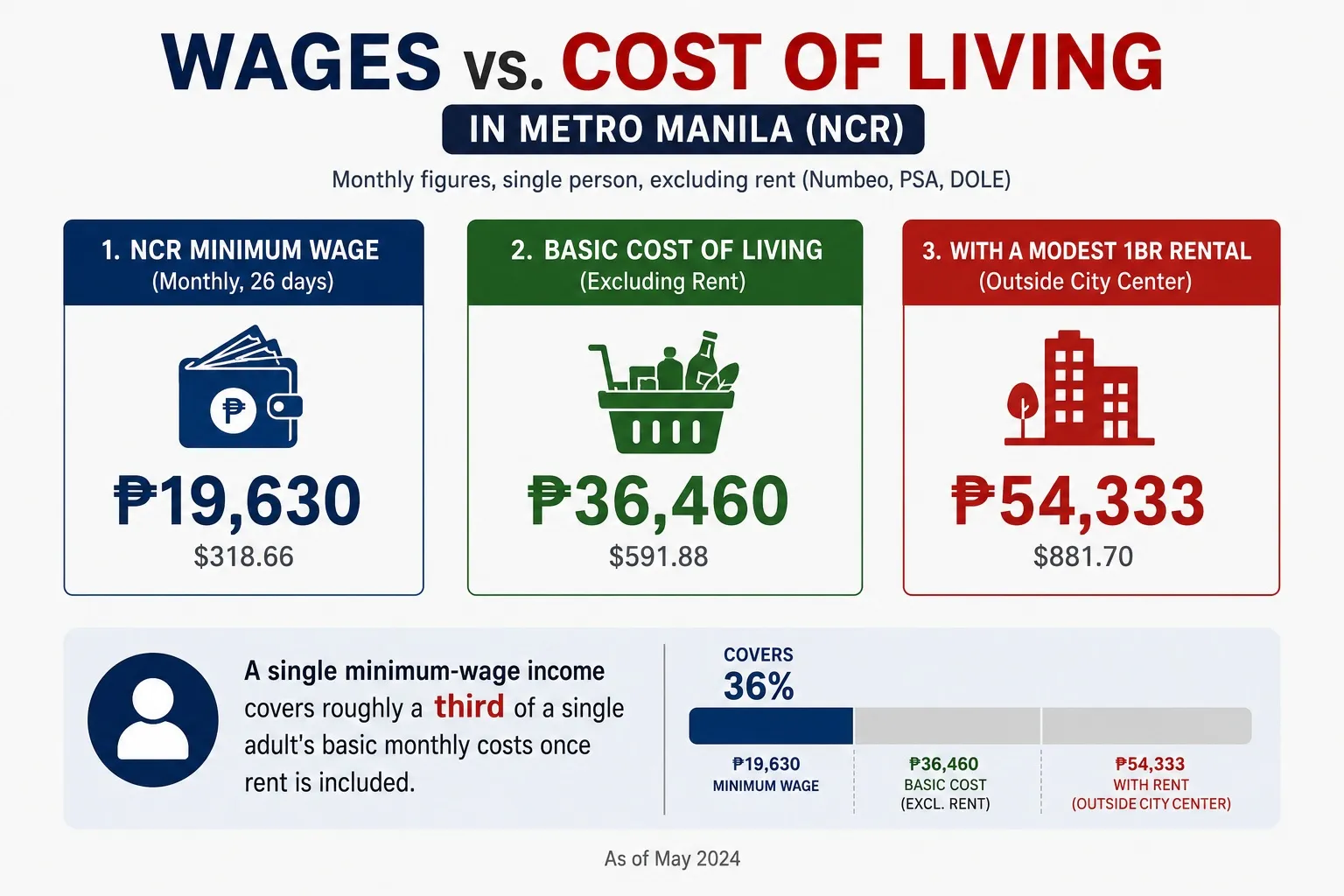
That basket alone runs roughly ₱130 to ₱140 (about $2.11 to $2.27), before rice, fresh produce, protein beyond canned goods, transport fare, or utilities are factored in. Against the current NCR daily minimum wage of ₱695 ($11.28), a single day's pay covers this kind of basket about five times over in isolation, but that math collapses fast once rent, transport, school costs, and a full week of meals for more than one person enter the picture, which lines up with the ₱54,333 ($881.70) monthly baseline covered earlier for a single person living independently in Manila.
Why the Suggested Price List Itself Matters
The existence of this list ties directly into the DTI intervention covered above: manufacturers agreeing to hold prices steady on items like canned sardines, corned beef, and condensed milk despite rising fuel and logistics costs. The SRP list is the enforcement mechanism for that commitment. Prices for staples like Datu Puti soy sauce (₱21.25, $0.34), Silver Swan patis (₱26.00, $0.42), and Purefoods luncheon meat (₱40.00, $0.65) are effectively frozen reference points, not market-driven prices, a direct government response to the same transport and fuel inflation (12.8 percent year-on-year in June 2026) covered in the previous section.
The Bigger Picture
Put together, three data points now tell a connected story: the minimum wage sets what a worker earns, the CPI report shows how fast that peso is losing ground (6.4 percent national inflation, 8.0 percent on housing and utilities), and this SRP list shows the government actively trying to hold the line on the specific basket of goods that wage is meant to cover. When a canned goods staple or a bar of soap creeps even a few pesos above this list, it isn't just a minor price bump. Against a daily wage still under ₱800 (about $13), it's a measurable bite out of a household's already tight monthly math.
Philippine Wages in a Global Context
Everything so far, the minimum wage, the inflation eating into it, the grocery basket it barely covers, has been a local picture. Zooming out from that basket-level view, the next question is how far a Philippine wage actually goes compared to other countries, since that comparison is exactly what drives both the outsourcing industry covered earlier and the decisions covered next. Comparing the Philippines to abstract dollar figures is easy to misread without seeing where it sits among other outsourcing destinations. Companies aren't only weighing the Philippines against the US, they're weighing it against Vietnam, Indonesia, Thailand, and India as competing outsourcing destinations.
| Country | Min. Wage (Monthly, USD) |
|---|---|
| Philippines (NCR) | ~$319 |
| Vietnam | $140 – $201 |
| Indonesia | $130 – $324 |
| Thailand | $252 – $311 |
| China (highest province, Shanghai) | ~$378 |
| Mexico (national floor) | ~$460 |
| Global Average (all countries) | ~$867 |
| US (federal floor, unchanged since 2009) | ~$1,257 |
| Germany (national minimum) | ~$2,408 |
| UK (National Living Wage, 21+) | ~$2,801 – $2,915 |
| Australia (national minimum) | ~$2,830 (A$) |
| US (Washington State, highest US state) | ~$2,968 |
| Luxembourg (highest in the world) | ~$3,156 |
Figures are monthly minimum-wage floors converted to USD at prevailing 2026 exchange rates. National averages and Philippines figures use the ~₱61.60 = $1 rate applied throughout this article; other currencies use their respective rates as reported by each source. Treat as directional, not exact, since exchange rates and wage orders both move throughout the year.
On a pure minimum-wage basis, the Philippines isn't the region's cheapest option, it's roughly mid-pack among Southeast Asian outsourcing hubs, above Vietnam and most of Indonesia, roughly on par with Thailand, and below only the wealthiest Chinese cities. It sits far below Western economies: Germany, the UK, Australia, and Luxembourg all pay four to ten times the NCR floor, and even the stagnant US federal minimum wage, unchanged since 2009, is roughly four times higher in nominal dollar terms. That is part of why the country markets itself on English fluency and cultural fit rather than being the absolute lowest bidder on labor cost. Nominal USD comparisons also understate what a wage actually buys locally: purchasing power parity adjustments generally show minimum-wage workers in lower cost-of-living countries can afford more per dollar-equivalent than the raw conversion suggests.
Why Filipinos Find It Good to Work Abroad
The global comparison above is exactly the calculation millions of Filipino households already make every year. When a domestic minimum wage floor sits at roughly $319 a month and a comparable role in the US, UK, Saudi Arabia, or Singapore pays several times that even after accounting for a higher cost of living abroad, working overseas becomes one of the most direct ways to close the gap this article has been tracking.
The scale of that choice shows up clearly in the numbers. Total cash remittances from Overseas Filipino Workers hit a record $35.634 billion in 2025, according to the Bangko Sentral ng Pilipinas, up 3.3 percent from $34.493 billion in 2024. Remittances have historically made up close to 8.9 to 10 percent of Philippine GDP, a structural pillar of the economy rather than a side effect of it.
| Source Country | Share of 2025 Cash Remittances |
|---|---|
| United States | 39.7% |
| Singapore | 7.3% |
| Saudi Arabia | 6.6% |
| Japan | 5.0% |
| United Kingdom | 4.6% |
| United Arab Emirates | 4.6% |
| Canada | 3.5% |
| Qatar | 2.9% |
| Taiwan | 2.8% |
| Hong Kong | 2.5% |
PSA's most recent Survey on Overseas Filipinos estimated roughly 2.19 million OFWs currently deployed, with the average worker remitting ₱129,000 (about $2,094) during the survey period, up from ₱123,000 (about $1,997) a year earlier. A third of that group sent home ₱100,000 or more. Separately, the Department of Migrant Workers' broader stock estimate, which includes permanent and long-term migrants alongside currently deployed contract workers, puts the total Filipino diaspora abroad at roughly 11.2 million people.
The appeal lines up directly with the wage gap covered throughout this article. A Filipino domestic worker, nurse, or seafarer earning even a modest wage in the US, UK, Saudi Arabia, or Singapore is typically earning several multiples of the NCR peso-equivalent minimum wage once converted home, and for many roles abroad, especially domestic and healthcare work, housing, food, or transport costs are partly or fully covered by the employer, which changes the real math further in the worker's favor. Combined with a weaker peso boosting the value of every dollar, riyal, or pound sent home, that gap is large enough to outweigh the real costs of working abroad: recruitment and placement fees, time away from family, and the adjustment of living in an unfamiliar country. For a large share of Filipino households, that trade-off still comes out ahead of what the domestic wage and cost-of-living numbers earlier in this article can offer.
Beyond BPO: How Filipinos Are Finding Other Ways to Earn More
Working abroad isn't the only route Filipinos have found around the wage-versus-cost-of-living gap covered in this article. A parallel shift has been happening inside the country, and online, as Filipinos increasingly build income from content creation, virtual assistant work, broader freelancing, and online selling, often stacked on top of a regular job rather than replacing it.
1. The Rise of Content Creators
The Philippines is one of TikTok's fastest-growing markets, with 62.3 million active users, or roughly 51 percent of the population, visiting the platform monthly, and Filipino users rank among the top five worldwide for average daily time spent on the app. Monetization has also improved: TikTok's Creator Rewards Program now pays roughly $0.50 to $1 per 1,000 views, a sharp jump from the $0.02 to $0.04 per 1,000 views under the platform's older Creator Fund, with additional income streams from livestream gifts, brand sponsorships, and affiliate commissions on products sold through videos.
The income picture is real but uneven. A handful of creators report earning well into six figures a year once sponsorships and affiliate commissions are factored in, but the platform's own payout structure means most creators, especially those without a large or highly engaged following, earn far more modest amounts from view-based payouts alone. For most Filipino creators, content income functions as a supplement to other work rather than a guaranteed replacement for it, though the ceiling is high enough that a growing number are treating it as a primary career.
2. The Rise of Virtual Assistants
The Philippines is the largest single-country source of virtual assistants in the world, accounting for roughly 13 percent of the global VA workforce, with an estimated 1.5 million Filipinos working as VAs for international clients as of 2022. Demand keeps climbing alongside the wider VA market, which analysts project to grow from about $6.5 billion in 2026 to $43.4 billion by 2035.
| VA Level | Rate (USD/hour) | Monthly Equivalent |
|---|---|---|
| Entry-Level / General Admin | $4.80 – $8.00 | $845 – $1,408 |
| Mid-Level / Specialized | $7.00 – $15.00 | $1,232 – $2,640 |
| Senior / Technical Specialist | $12.00 – $25.00 | $2,112 – $4,400 |
A 2026 analysis of 586 real Filipino VA job applications found a median asking rate of $714 a month (about ₱44,000), with the middle half of applicants asking between $536 and $893. That is roughly 80 percent below the median US administrative assistant salary of about $3,800 a month, which is exactly the arbitrage that makes VA work attractive to foreign employers, but it is also several multiples of the ₱695 ($11.28) NCR daily minimum wage covered earlier once converted to a monthly basis.
3. Freelancing and the Wider Gig Economy
Beyond dedicated VA work, the Philippines ranks among the world's top five freelancing countries, generating an estimated $1.2 billion in annual freelance revenue, with roughly 1.5 million Filipinos registered on international freelance platforms. A Payoneer and GCash survey of Filipino freelancers found average hourly rates of $11 to $22, project-based rates of $27 to $33, and average monthly retainers between $626 and $979, well above typical local BPO and minimum-wage benchmarks. The top categories of freelance work are sales and marketing (32 percent), customer service (21 percent), and data entry or internet research, and a PSA labor force estimate puts the country's total gig workforce, including offline and informal gig work, at close to 9.9 million people, about 22 percent of all employed Filipinos.
4. Online Selling and Social Commerce
A fourth path has grown alongside the first three: selling directly to consumers through Shopee, Lazada, TikTok Shop, and Facebook Marketplace. Combined gross merchandise value across Shopee, Lazada, and TikTok Shop in the Philippines reached an estimated $22 billion in FY2025, up 15 percent from $19 billion the year before, and social commerce, driven heavily by TikTok Shop's live-selling format, now accounts for roughly 35 percent of all online sales in the country. Entry costs are low: TikTok Shop charges around 1 to 2 percent in transaction fees, while Shopee and Lazada charge 2 to 8 percent depending on category, making online reselling and small-batch product sales an accessible side income for many Filipinos, and in a growing number of cases, a full replacement for traditional employment.
What ties all four paths together is the same math driving the OFW numbers above: each one offers a route to income that isn't capped by the local minimum wage or tied to a single peso-denominated paycheck. None of them are guaranteed or evenly distributed, income in content creation and freelancing is famously top-heavy, and VA and gig platform income still depends on finding and keeping foreign clients, but for a growing share of Filipino workers, these are no longer fringe options. They function as a genuine third lane alongside a local BPO job and an overseas contract, one more way of closing the same gap this entire article has been tracking.
One Last Thing
Put the four parts of this article together and the picture is a single, connected story rather than four separate ones. Minimum wage and BPO pay set what a Filipino worker earns. Inflation and the grocery basket show how fast that peso loses ground before it's even spent. The global comparison explains why that same wage, modest by NCR standards, is still large enough to pull millions of Filipinos toward jobs abroad or toward building income at home through content creation, virtual assistant work, freelancing, or online selling. None of those four parts makes full sense without the other three.
For outsourcing clients abroad, most of this is invisible, since USD-denominated pay isn't directly exposed to peso inflation. But it's a live factor in why local minimum wage keeps needing revision, why OFW deployment and remittances keep climbing, why the local creator and gig economy keeps growing, and why the "cheap labor" framing understates how much ground Filipino workers are actually running just to hold their position.
Looking to hire or compare BPO employers in the Philippines? Browse BPO and call center listings on azifind.com.
Frequently Asked Questions
What is the minimum wage in the Philippines in 2026?
There is no single national minimum wage. Metro Manila (NCR) has the highest regional rate, currently 695 pesos (about $11.28) a day for non-agricultural workers, rising to 755 pesos ($12.26) on July 25, 2026 and 780 pesos ($12.66) by January 20, 2027 under Wage Order No. NCR-27. Other regions are set independently by their own Regional Tripartite Wages and Productivity Boards and are generally lower.
How much is the NCR minimum wage in USD?
At roughly 61.6 pesos to the US dollar, the current NCR daily minimum wage of 695 pesos is about 11.28 dollars a day, rising to about 12.26 dollars after the July 2026 increase. Monthly, based on a 26-day work schedule, that is roughly 293 to 319 US dollars.
Is minimum wage in the Philippines enough to live on?
For a single person living independently in Metro Manila, generally no. Numbeo estimates basic monthly costs excluding rent at around 36,460 pesos (about $591.88), and adding even a modest one-bedroom rental outside the city center pushes baseline costs well above what a single minimum-wage income covers, which is why many households pool income across multiple working family members.
Why is minimum wage lower outside Metro Manila?
Minimum wage in the Philippines is set regionally, not nationally, by 17 separate Regional Tripartite Wages and Productivity Boards under the National Wages and Productivity Commission. Each board sets rates based on local cost of living, economic conditions, and employer capacity to pay, which is why provincial rates typically run 20 to 50 percent below NCR.
What is the current inflation rate in the Philippines?
Headline inflation was 6.4 percent year-on-year in June 2026, according to the Philippine Statistics Authority, down slightly from 6.8 percent in May 2026. Core inflation, which excludes volatile food and energy prices, actually rose to 4.4 percent, suggesting price pressure is broadening beyond fuel and food alone.
Why did inflation rise so much in 2026?
The largest driver has been transport costs, up 12.8 percent year-on-year in June 2026, tied to fuel price shocks from the Middle East conflict. Housing, water, electricity, and gas followed closely at an 8.0 percent annual increase nationally, with food inflation elevated at 5.4 percent, led by rice at 15.0 percent.
How much does a BPO or call center agent earn in the Philippines?
Entry-level call center agents typically start between 15,000 and 28,000 pesos a month (about $243 to $455), close to or slightly above the local minimum wage. Mid-level agents and specialists earn 25,000 to 45,000 pesos ($406 to $731), and team leads or supervisors can reach 40,000 to 120,000 pesos ($649 to $1,948) or more depending on the company and account.
How does Philippine minimum wage compare to other Southeast Asian countries?
On a monthly USD basis, NCR minimum wage of roughly 319 dollars sits above Vietnam's regional floor of 140 to 201 dollars and above most Indonesian provinces outside Jakarta, roughly on par with Thailand, and below only the wealthiest Chinese cities like Shanghai. Within Southeast Asia specifically, the Philippines is closer to mid-pack than the region's cheapest option.
How does Philippine minimum wage compare to the US and UK?
It is far lower in nominal dollar terms. The US federal minimum wage floor works out to roughly 1,257 dollars a month, and the UK National Living Wage for workers 21 and over is roughly 2,801 to 2,915 dollars a month, both several times higher than the NCR floor of about 319 dollars. Purchasing power parity narrows but does not close this gap.
Why do foreign companies outsource to the Philippines?
Primarily cost arbitrage combined with English fluency and cultural familiarity with Western business norms. A Philippines-based role typically costs a US or UK employer 70 to 80 percent less than the same role hired domestically, while still paying several times the local minimum wage, which is why the arrangement can be simultaneously cheap for the employer and comparatively well-paid for the worker.
Is the Philippines the cheapest outsourcing destination in Asia?
No. On pure minimum-wage terms, Vietnam and most of Indonesia are cheaper. The Philippines competes on English proficiency, a large university-educated labor pool, and decades of BPO-industry infrastructure and management experience rather than being the lowest bidder on labor cost alone.
Are labor groups satisfied with the 2026 NCR wage increase?
No. Labor coalition Unity for Wage Increase Now (UWIN) filed an appeal with the National Wages and Productivity Commission calling the 85-peso (about $1.38) increase under Wage Order NCR-27 grossly inadequate given current inflation, and is pushing for a 505-peso ($8.20) increase instead.
What is the Purchasing Power of the Peso (PPP) in NCR right now?
According to PSA, the Purchasing Power of the Peso in NCR stood at 0.77 in June 2026, meaning one peso in 2018 is worth only about 77 centavos of real purchasing power today. That is down from 0.80 a year earlier, in June 2025.
Which Philippine region had the highest inflation in June 2026?
Central Visayas (Region VII) posted the highest regional inflation in the country at 10.0 percent in June 2026, followed by Caraga at 8.9 percent and BARMM at 8.0 percent. NCR, by comparison, ran at a comparatively mild 4.9 percent.
How is the DTI keeping basic goods affordable?
The Department of Trade and Industry negotiates directly with manufacturers to hold suggested retail prices steady on canned goods, milk, bread, coffee, noodles, and other basic necessities, particularly during fuel price shocks. As of May 2026, DTI reported that 68 percent of monitored products had no price increase at all.
How much do OFW remittances contribute to the Philippine economy?
Total cash remittances from Overseas Filipino Workers hit a record $35.634 billion in 2025, up 3.3 percent from $34.493 billion in 2024, according to the Bangko Sentral ng Pilipinas. Remittances have historically made up roughly 8.9 to 10 percent of Philippine GDP, making OFW income a structural pillar of the economy rather than a side effect of it.
How much can Filipino content creators earn on TikTok and YouTube?
TikTok's Creator Rewards Program pays roughly $0.50 to $1 per 1,000 views, up sharply from $0.02 to $0.04 under the platform's older Creator Fund, with additional income possible from livestream gifts, brand sponsorships, and affiliate commissions. Earnings are highly uneven: a small number of creators report six-figure annual income once sponsorships are included, but most Filipino creators earn far more modest, supplemental amounts from view-based payouts alone.
Can Filipino virtual assistants really earn more than local minimum wage?
Yes, generally. A 2026 analysis of real Filipino VA job applications found a median asking rate of $714 a month, well above the peso-equivalent of the NCR minimum wage even after accounting for a full working month. Entry-level VAs typically ask $4.80 to $8 an hour, while senior or technical specialists can command $12 to $25 an hour.
How big is the online selling and social commerce economy in the Philippines?
Combined gross merchandise value across Shopee, Lazada, and TikTok Shop in the Philippines reached an estimated $22 billion in FY2025, up 15 percent from $19 billion the year before. Social commerce, driven largely by TikTok Shop's live-selling format, now accounts for roughly 35 percent of all online sales in the country.
Hiring or comparing BPO employers in the Philippines?
Browse our directory of BPO and call center companies across Metro Manila, or add your business if it isn't listed yet. Both are free.
Sources & Citations
Wages & Labor Law
- Wage Order No. NCR-27, Regional Tripartite Wages and Productivity Board – NCR / National Wages and Productivity Commission — nwpc.dole.gov.ph/ncr
- Philippine Statistics Authority, 2024 Occupational Wages Survey — psa.gov.ph/statistics/occupational-wages-survey
- Philippine Statistics Authority, 2024 Occupational Wages Survey Statistical Tables (Table 1: by Major Industry Group; Table 2: by Region), released with the November 25, 2025 press release — PSA-published Excel workbook, full industry and regional breakdowns used for the complete tables in this article
- Philstar, “Labor groups push for higher wage increase,” Rhodina Villanueva, July 18, 2026 — philstar.com
Inflation & Cost of Living
- Philippine Statistics Authority, Summary Inflation Report, CPI (2018=100): June 2026 — psa.gov.ph
- PSA-NCR, regional CPI detail, June 2026 — rssoncr.psa.gov.ph
- Department of Trade and Industry, Latest SRPs of Basic Necessities and Prime Commodities — dti.gov.ph
- Numbeo, Cost of Living in Manila — numbeo.com/cost-of-living/in/Manila
BPO & Call Center Pay
- Bossjob, “Call Center Salary Philippines in 2026” — bossjob.ph
- PayScale, Call Center Agent Salary in Philippines — payscale.com
- MultiplyMii, “The $500 Question: A 2026 Philippines Salary Guide for Outsourcing” — multiplymii.com
Global Minimum Wage Comparison
- Skuad, “Minimum Wage by Country: 2026 Global Employer Guide” — skuad.io
- PEOrient, “2026 Minimum Wage by Country: Rates, Compliance, Cost” — peorient.com
- HelloPebl, “Minimum Wage by Country in 2026: A Guide for Global Employers” — hellopebl.com
- Deel, “Minimum Wage by Country: Global Guide for 2025/2026” — deel.com
- Trading Economics, Vietnam Minimum Wages — tradingeconomics.com
- Wage.is, Indonesia vs. Vietnam wage comparison — wage.is
- Wage.is, Thailand average and minimum salary — wage.is/thailand
- China Briefing, “Minimum Wages in China: A Complete Guide” — china-briefing.com
OFW Remittances & Deployment
- Philippine Statistics Authority, Survey on Overseas Filipinos — psa.gov.ph
- BusinessWorld, “OFW remittances hit record $35.6B,” Katherine K. Chan — bworldonline.com
- Trading Economics, Philippines Cash Remittances — tradingeconomics.com/philippines/remittances
- BatasKo, OFW Statistics Philippines 2026 — batasko.com/data/ofw
Content Creators, Virtual Assistants & Gig Economy
- Ecomobi, “How to earn money in TikTok 2026” — ecomobi.com
- HireTalent.ph, “Filipino Virtual Assistant Market Statistics for 2026” — hiretalent.ph
- HireTalent.ph, “Virtual Assistant Salary in the Philippines 2026” — hiretalent.ph
- VA Masters, “Cost of Hiring a Virtual Assistant in the Philippines 2026” — stealthagents.com
- Armasourcing, “Filipino VA Salary Report 2026: Data From 586 Applications” — armasourcing.com
- SQ Magazine, “Freelance Economy Statistics 2026” — sqmagazine.co.uk
- MicroSourcing, “Philippines gig economy: The insights and risks” (PSA Labor Force Survey data) — microsourcing.com
- Payoneer, “Top 10 Freelancing Countries” (Payoneer/GCash Philippines Freelance Report) — payoneer.com
- Cube, “E-commerce in Philippines: Market Size, Platforms & Trends 2026” — cube.asia
Exchange Rate
- Xe, USD to PHP — xe.com
- Wise, USD to PHP — wise.com
- Yahoo Finance, USD/PHP quote — finance.yahoo.com
USD conversions throughout this article use approximately ₱61.60 = $1 (mid-July 2026) unless otherwise noted. Exchange rates fluctuate daily; treat all USD figures as directional, not exact. Several BPO and global-wage figures come from industry blogs and staffing agencies rather than government statistics; they are directionally consistent with each other but are market estimates, not official data.