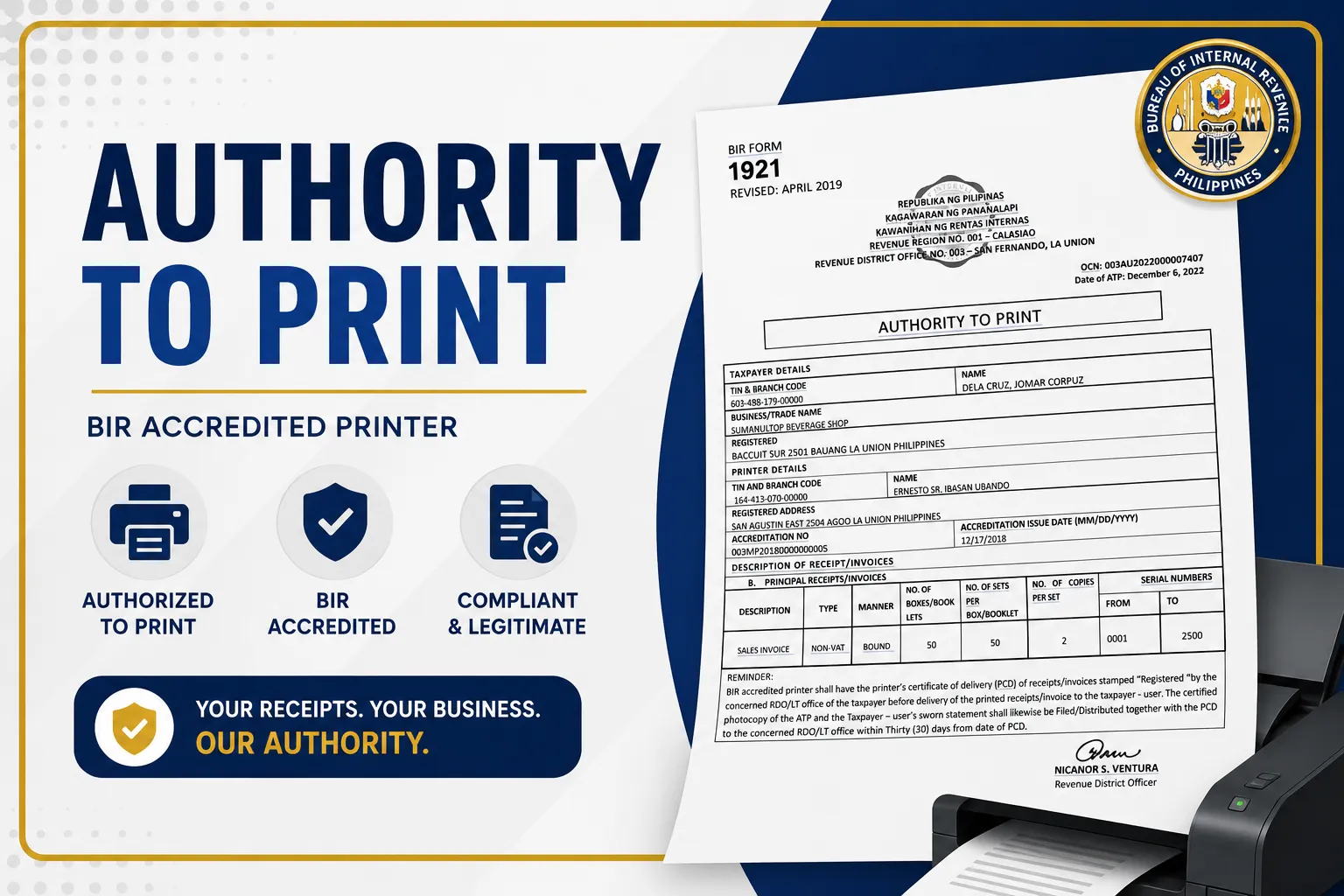
Getting your Certificate of Registration does not yet let you bill anyone properly. Before you can issue a valid invoice to a client, you need an Authority to Print, the BIR's permission to have your invoices printed.
This is the last of the setup steps on the registration hub. Here is what the ATP is, how to apply for it on Form 1906, what your invoices must contain, and how the rules changed under the EOPT Act and RR 6-2022.
Key Takeaways
- An Authority to Print (ATP), applied for on Form 1906, lets a BIR-accredited printer produce your invoices.
- Under EOPT, the Invoice replaced the Official Receipt as the primary document for services.
- A homemade PDF or Canva template is not a valid BIR invoice. It must come from an accredited printer or a registered e-invoicing setup.
- Under RR 6-2022, printed invoices no longer expire. They are valid until used up, so you reapply when serial numbers run low.
- Alternatives exist: buy BIR Printed Receipts/Invoices, or register a computerized invoicing system through ORUS.
The Complete BIR Registration Process
The full path from unregistered to filing. Grey steps are for everyone; tagged steps apply to specific registrants.
Sole proprietors start here
Register your business name (DTI)
Register your trade name in the DTI BNRS. Valid five years.
Barangay clearance and Mayor's Permit
Local clearances for a physical business, secured before the BIR.
The BIR process, for everyone
Secure or update your TIN
One TIN for life. If you had a job, transfer your RDO with Form 1905.
File BIR Form 1901
Apply at the New Business Registrant Counter, by email via NewBizReg, or online via ORUS.
Pay the P30 DST
The only fee at registration. The P500 annual fee was abolished in 2024.
Get your COR (Form 2303)
Your certificate of tax types. You choose 8% or graduated here.
Register your books of accounts
A journal and ledger, manual, loose-leaf, or through ORUS.
Get an ATP, then invoices
Form 1906, printed by a BIR-accredited printer, or a registered e-invoicing setup.
Online earners add this
Display your Registration Seal Badge
A QR-coded badge on your storefront and channels, generated through ORUS.
File and pay your taxes, every quarter
Registration is one-time. Filing is the ongoing part. This is where you go next.
What the Authority to Print Is
The Authority to Print is a document issued by your RDO that authorizes a BIR-accredited printer to print your official invoices in a specific serial range. Without an ATP, no accredited printer can legally produce your booklets, and a plain layout you design in Canva, Word, or an invoicing app is not a valid BIR invoice.
The ATP covers both principal invoices, which you issue for the sale of your services or goods, and supplementary invoices such as billing statements or collection receipts, if you use them. For most solo freelancers, the principal invoice is the only document that matters.
Invoice, Not Official Receipt
Under the Ease of Paying Taxes (EOPT) Act, the Invoice replaced the Official Receipt as the primary sales document for services. A freelancer selling services now issues a service invoice, and a seller of goods issues a sales invoice, not an OR. If you registered before the shift and still hold old Official Receipt booklets, you may use them only after converting them into invoices under the BIR's transitional rules, not by informally relabeling them. Any new ATP you apply for today is for invoices.
What You Need to Apply
Prepare the following for your ATP application:
- BIR Form 1906 (Application for Authority to Print Receipts and Invoices), accomplished and signed.
- A final and clear sample layout of the invoice you intend to use, showing all required fields. Your accredited printer usually prepares this as a job order.
- A copy of your Certificate of Registration (Form 2303).
- A valid government-issued ID.
- The details of your chosen BIR-accredited printer.
The ATP Process, Step by Step
From Printer to Booklet
Most accredited printers help file the paperwork with your RDO.
Choose a BIR-accredited printer
Only accredited printers can print your invoices. Verify accreditation first; most handle the RDO paperwork for you.
Prepare the invoice layout
Work with the printer on a final sample carrying every required field. This is submitted with your application.
Accomplish BIR Form 1906
Fill it out completely, matching the registered name and TIN on your COR.
File with your RDO or via ORUS
Submit Form 1906, the invoice sample, and your COR copy. ORUS now also supports ATP applications.
Receive your ATP
The RDO issues the Authority to Print, specifying your printer and the inclusive serial numbers authorized.
Get your invoices printed
The accredited printer produces your booklets, each invoice pre-numbered in sequence with the ATP details.
Keep the ATP on file
Retain it with your books. You reference it when you apply for your next batch.
What Your Invoice Must Show
A compliant invoice generally carries:
- Your registered name and, if you use one, your business style.
- Your TIN and registered business address.
- A Non-VAT notation, if you are a non-VAT taxpayer, which most new registrants are.
- A pre-printed serial number in the authorized range.
- Space for the date, client name, client TIN and address, description, and amount.
- The printer's accreditation details and ATP number in the footer.
Issue the invoice for the gross amount even when a client withholds tax. The client withholds their Expanded Withholding Tax and gives you a Form 2307; your invoice still reflects the full amount before withholding, and the 2307 becomes a tax credit you claim later.
Your Invoices No Longer Expire
This is the rule most old guides get wrong. Under RR No. 6-2022, effective July 16, 2022, the BIR removed the five-year validity period on printed receipts and invoices.
What this means in practice
- Your ATP-printed invoices are valid until fully exhausted, with no expiry date to track.
- The old footer line about being valid for five years is disregarded on existing stock.
- You apply for a new ATP when you are running low on serial numbers, not when a date lapses.
Because there is no longer a hard expiry, the trigger is inventory. Order your next batch before your current booklets run out, since issuing a client an invoice you do not have authority for is a penalty.
Alternatives to a Printed ATP
If manual booklets do not suit how you work, two other routes issue valid invoices:
- BIR Printed Receipts/Invoices (BPR/BPI). You buy pre-printed BIR invoices directly, which some use as a low-volume starting point instead of a full print run.
- Computerized system or e-invoicing. Register a computerized accounting system or an invoicing setup through ORUS and issue system-generated invoices. This suits higher volume, and online sellers may face an e-invoicing requirement of their own.
For a typical solo freelancer issuing a handful of invoices a month, the printed ATP route remains the most common, and a booklet usually costs around P1,500, depending on the printer.
Find a Digital Marketing Agency Near You
Prefer to hand this off? These providers are listed in the azifind directory. Compare and shortlist before you commit.
Deloitte Philippines (Cebu office)
Philippines
Diaz Murillo Dalupan and Company Cebu Branch
Philippines
DMA Global Accounting Services Co.
Philippines
Espina Perez- Espina & Associates
Philippines
FCO Accountants
Philippines
Hermosada & Co., CPA's
Philippines
Lily Villamala Ceniza and Associates ( LVCA )
Philippines
MB&A CPAS
Philippines
Mora, Sanchez, Meñoza and Associates or MSMA (formerly R. P. Mora & Co.)
Philippines
R Talaba Accounting Firm
Philippines
Common ATP Mistakes to Avoid
The most common is using a non-accredited printer. The invoices are invalid even if they look correct.
The second is treating a homemade PDF as an invoice. A self-made template is not BIR-registered, no matter how professional it looks.
The third is running out of serial numbers. Reapply before your last booklet is used, not after.
The fourth is mismatched details. The name and TIN on your invoice layout must match your COR exactly.
One Last Thing
The ATP is the last setup step, alongside registering your books of accounts. Once your invoices are printed and your books are registered, you are fully set up to operate, and your attention shifts from registering to filing and paying your taxes on schedule. If you have not registered yet, start at the hub.
Frequently Asked Questions
What is an Authority to Print?
It is a document issued by your RDO that authorizes a BIR-accredited printer to print your invoices in a specific serial range. You apply for it on BIR Form 1906. Without an ATP, no accredited printer can legally produce your booklets, and a plain layout you design yourself is not a valid BIR invoice.
Do my printed invoices still expire after five years?
No. Under RR 6-2022, effective July 16, 2022, the BIR removed the five-year validity period on printed receipts and invoices. Your ATP-printed invoices are valid until fully used, with no expiry date to track. You apply for a new ATP when you are running low on serial numbers, not when a date lapses.
Can I just print my own invoices or use a Canva template?
No. Invoices must be printed by a BIR-accredited printer under your ATP, or generated by a registered computerized or electronic invoicing system. A self-made template, PDF, or Canva design is not a BIR-registered invoice, no matter how professional it looks.
What is the difference between a service invoice and a sales invoice?
A service provider issues a Service Invoice, while a seller of goods issues a Sales Invoice. Under the EOPT Act both are simply invoices, and the invoice replaced the Official Receipt as the primary document for services. Either way you need an ATP or a registered e-invoicing setup.
How much does it cost to print invoices?
Printing cost varies by the accredited printer, but a booklet typically runs around P1,500. The ATP application itself does not carry a separate fee, though your registration involved the P30 documentary stamp tax.
Are there alternatives to a printed ATP?
Yes. You can buy BIR Printed Receipts or Invoices (BPR/BPI) directly, which some use as a low-volume starting point, or you can register a computerized accounting system or invoicing setup through ORUS and issue system-generated invoices. The printed ATP route remains the most common for a solo freelancer.
Invoices sorted? Get found by clients
With your invoices registered, you are ready to bill. Make sure clients can find you too. Claim or add your free listing on azifind to appear on the city and category pages people use to find businesses like yours.