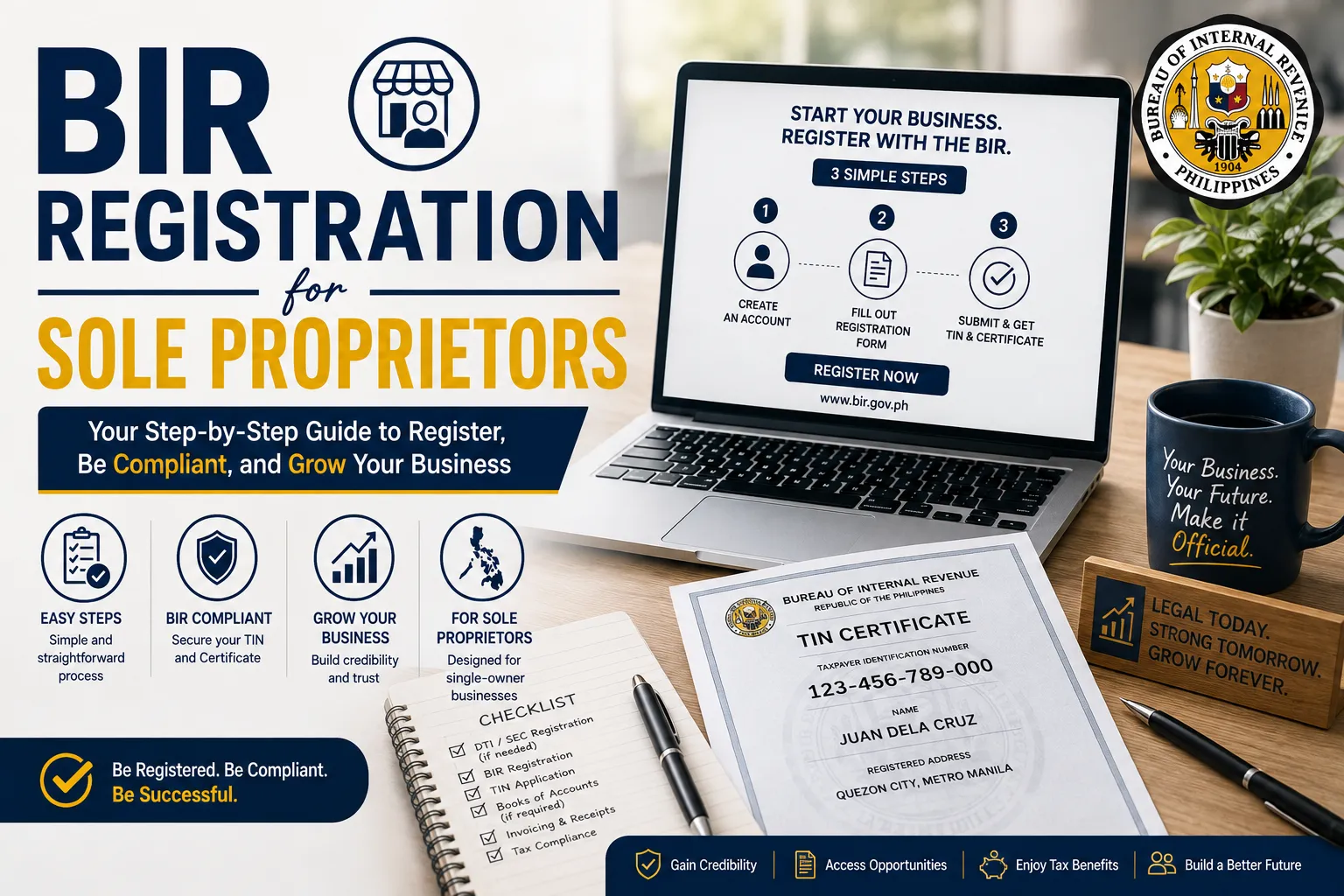
If you run a single-owner business, a shop, a stall, a small trade, or a service under a business name, you are a sole proprietor, and the BIR requires you to register.
The BIR mechanics are the same as any new business and are covered on the main registration hub: TIN, Form 1901, the P30 DST, your Certificate of Registration, books, and invoices. What is different for a sole proprietor is the layer that comes before the BIR: registering your business name with DTI and securing your local permits. This guide covers that layer and the order it happens in.
Key Takeaways
- A sole proprietor registers in order: DTI business name, then Barangay clearance, then Mayor's Permit, then the BIR.
- DTI Business Name registration is required if you use a trade name, and it is valid for five years.
- Unlike a home-based freelancer, you need a Barangay Business Clearance and a Mayor's or Business Permit.
- A seller of goods issues a Sales Invoice, secured through an Authority to Print or a registered e-invoicing setup.
- If your total assets are P3 million or less, a BMBE registration can exempt your business income from income tax.
The Complete BIR Registration Process
The full path from unregistered to filing. Grey steps are for everyone; tagged steps apply to specific registrants.
Sole proprietors start here
Register your business name (DTI)
Register your trade name in the DTI BNRS. Valid five years.
Barangay clearance and Mayor's Permit
Local clearances for a physical business, secured before the BIR.
The BIR process, for everyone
Secure or update your TIN
One TIN for life. If you had a job, transfer your RDO with Form 1905.
File BIR Form 1901
Apply at the New Business Registrant Counter, by email via NewBizReg, or online via ORUS.
Pay the P30 DST
The only fee at registration. The P500 annual fee was abolished in 2024.
Get your COR (Form 2303)
Your certificate of tax types. You choose 8% or graduated here.
Register your books of accounts
A journal and ledger, manual, loose-leaf, or through ORUS.
Get an ATP, then invoices
Form 1906, printed by a BIR-accredited printer, or a registered e-invoicing setup.
Online earners add this
Display your Registration Seal Badge
A QR-coded badge on your storefront and channels, generated through ORUS.
File and pay your taxes, every quarter
Registration is one-time. Filing is the ongoing part. This is where you go next.
The Order Matters for a Sole Proprietor
A freelancer can walk into the BIR with just an ID. A sole proprietor cannot, because the BIR issues your Certificate of Registration against a business that is already named and locally permitted. So the sequence runs through three offices before the BIR, then two BIR steps after.
In the process map above, your path runs through the amber lane first (DTI and permits), then the standard BIR steps. The three sole proprietor steps are covered next.
1. Register Your Business Name with DTI
If you trade under a business name rather than your own full name, you register that name with the DTI Business Name Registration System (BNRS) at bnrs.dti.gov.ph before the BIR. This gives you the right to use the name within a chosen territory and produces the DTI certificate the later steps ask for.
- Choose a territorial scope: barangay, city or municipality, regional, or national. The fee scales with scope, from around P200 up to about P2,000, plus a P30 documentary stamp tax.
- Validity: a DTI Business Name is valid for five years and must be renewed before it expires.
- If you use your own name only, you can skip DTI, but most shops and stores operate under a business name.
2. Secure Your Barangay Clearance and Mayor's Permit
This is the layer a home-based freelancer skips and a sole proprietor cannot. Because you operate a physical establishment, the local government needs to clear and permit it.
- Barangay Business Clearance, from the barangay where your business is located, is usually secured first and is a requirement for the city permit.
- Mayor's or Business Permit, from the city or municipal hall, is the main local license to operate. Requirements vary by LGU but commonly include your DTI certificate, the barangay clearance, proof of location such as a lease, and occupancy or sanitary clearances.
With your DTI certificate and these permits in hand, you have what the BIR needs to complete your registration.
3. Register with the BIR and Get Your Sales Invoices
Now you follow the standard process on the hub: file Form 1901, pay the P30 DST, receive your COR (Form 2303), and register your books of accounts. If you sell goods, your books should track inventory.
For your invoices, a seller of goods issues a Sales Invoice, while a service provider issues a Service Invoice. Under the EOPT Act both are simply invoices, and either way you need an Authority to Print or a registered electronic invoicing setup. A homemade invoice does not qualify.
Consider BMBE for Income Tax Exemption
A benefit that is specific to small business owners is the Barangay Micro Business Enterprise (BMBE). If your total assets are P3 million or less, excluding the land your business sits on, you can register as a BMBE, usually through a Negosyo Center or your local government, and receive a Certificate of Authority.
What BMBE gives you
Exemption from income tax on your business income, along with other incentives. It does not remove your duty to register with the BIR or to file returns, but it can meaningfully lower what you owe. If your business is small and asset-light, weigh this before you settle on a tax rate.
Choosing Your Tax Rate
If you are not a BMBE, you elect the 8 percent flat rate or the graduated rates at registration. A goods business with real cost of goods, inventory, and rent often does better on graduated rates, where those costs are deductible, than on the 8 percent rate, which taxes gross receipts. Run both against your numbers. The full comparison is in 8% vs graduated income tax.
Find a Digital Marketing Agency Near You
Prefer to hand this off? These providers are listed in the azifind directory. Compare and shortlist before you commit.
Deloitte Philippines (Cebu office)
Philippines
Diaz Murillo Dalupan and Company Cebu Branch
Philippines
DMA Global Accounting Services Co.
Philippines
Espina Perez- Espina & Associates
Philippines
FCO Accountants
Philippines
Hermosada & Co., CPA's
Philippines
Lily Villamala Ceniza and Associates ( LVCA )
Philippines
MB&A CPAS
Philippines
Mora, Sanchez, Meñoza and Associates or MSMA (formerly R. P. Mora & Co.)
Philippines
R Talaba Accounting Firm
Philippines
Common Sole Proprietor Mistakes to Avoid
The most common is going to the BIR first. Without your DTI certificate and local permits, the BIR cannot complete your registration, so you waste the trip. Follow the order.
The second is skipping DTI while using a business name. Operating under an unregistered trade name is a compliance gap and can block your permits.
The third is overlooking BMBE. Many small owners who qualify for an income tax exemption never register for it and pay tax they did not owe.
The fourth is picking the 8% rate by default. For a goods business with real costs, graduated rates with deductions are often cheaper, so do the math first.
One Last Thing
The BIR steps are the universal ones on the hub. As a sole proprietor, what is yours to get right is the order, DTI then Barangay then Mayor's Permit then BIR, issuing proper sales invoices, and checking whether BMBE and the graduated rate fit your business. Once registered, your attention shifts to filing and paying your taxes on schedule.
Frequently Asked Questions
Do I need DTI registration as a sole proprietor?
If you operate under a business or trade name rather than your own full name, yes. You register the name with the DTI Business Name Registration System before the BIR. If you trade purely under your personal name, DTI is not required, but most shops and stores use a business name, so most sole proprietors need it.
What is the correct order of registration for a sole proprietor?
Business name first with DTI, then your Barangay Business Clearance, then your Mayor's or Business Permit from the city or municipality, and finally the BIR using Form 1901. The BIR is the last step because your Certificate of Registration is issued against a business that is already named and locally permitted.
Do I need a Mayor's Permit? A freelancer guide said it was not required.
You do. That exemption is for home-based freelancers with no physical establishment. A sole proprietor operating a shop, stall, or office needs a Barangay Business Clearance and a Mayor's or Business Permit from the local government before completing BIR registration. It is one of the main ways a solo business owner's registration is heavier than a freelancer's.
What is BMBE and can it exempt me from income tax?
A Barangay Micro Business Enterprise (BMBE) is a business with total assets of not more than P3 million, excluding the land it operates on. Registering as a BMBE, usually through a Negosyo Center or the local government, grants income tax exemption on the business income and other incentives. If your business is small and asset-light, it is worth checking before you choose a tax rate.
Do I issue a sales invoice or a service invoice?
A seller of goods issues a Sales Invoice, while a service provider issues a Service Invoice. Under the EOPT Act both are simply "invoices," and either way you need an Authority to Print or a registered electronic invoicing setup. A homemade or Canva invoice does not qualify.
How much does DTI Business Name registration cost and how long is it valid?
The DTI fee depends on the territorial scope you choose, ranging from around P200 for barangay coverage up to about P2,000 for national coverage, plus a P30 documentary stamp tax. A DTI Business Name certificate is valid for five years and must be renewed before it expires.
Registered? Get found by local customers
Your permits and COR make the business legitimate. A listing makes it findable. Claim or add your free listing on azifind to appear on the city and category pages people use to find businesses like yours.