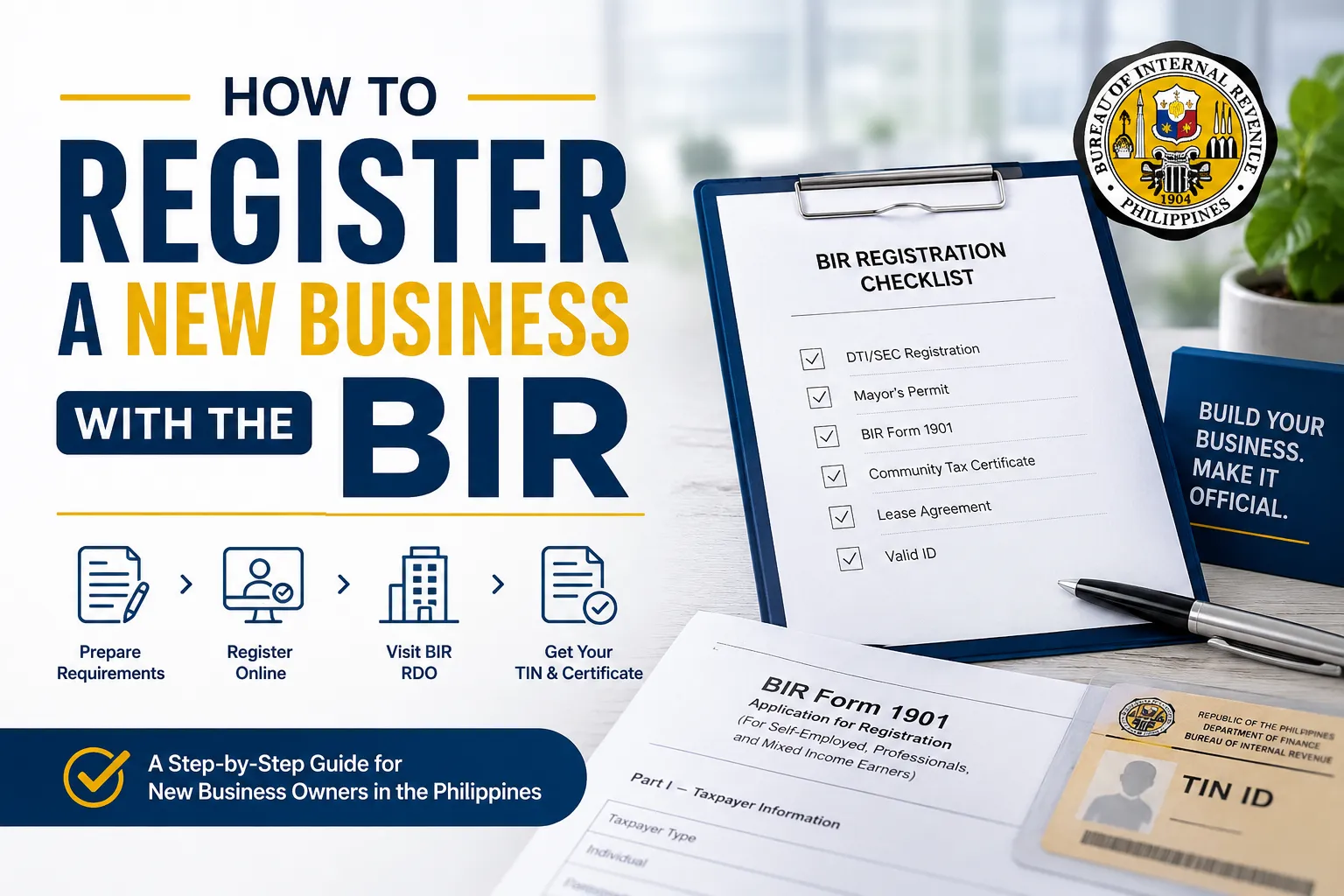
If you earn income from your own work or business in the Philippines, the Bureau of Internal Revenue requires you to register before you operate. Most guides make this feel like three different processes for three different people. It is one process with a few branches.
Whether you freelance, sell online, create content, or run a single-owner shop, the core steps are identical: get a TIN, file Form 1901, pay the P30 documentary stamp tax, claim your Certificate of Registration, register your books, and get your invoices. What follows is that shared process in full, plus a clear pointer to the guide for your specific situation.
Key Takeaways
- Registration is required once you earn from your own work, regardless of how small the income is.
- The only fee at registration is the P30 documentary stamp tax. The P500 annual fee was abolished in 2024.
- The process is the same for everyone: TIN, Form 1901, DST, Certificate of Registration, books, and invoices.
- You can register in person at the New Business Registrant Counter, by email through NewBizReg, or fully online through ORUS.
- The differences are in the documents and compliance items, which split into three registrant paths at the end of this guide.
The Complete BIR Registration Process
The full path from unregistered to filing. Grey steps are for everyone; tagged steps apply to specific registrants.
Sole proprietors start here
Register your business name (DTI)
Register your trade name in the DTI BNRS. Valid five years.
Barangay clearance and Mayor's Permit
Local clearances for a physical business, secured before the BIR.
The BIR process, for everyone
Secure or update your TIN
One TIN for life. If you had a job, transfer your RDO with Form 1905.
File BIR Form 1901
Apply at the New Business Registrant Counter, by email via NewBizReg, or online via ORUS.
Pay the P30 DST
The only fee at registration. The P500 annual fee was abolished in 2024.
Get your COR (Form 2303)
Your certificate of tax types. You choose 8% or graduated here.
Register your books of accounts
A journal and ledger, manual, loose-leaf, or through ORUS.
Get an ATP, then invoices
Form 1906, printed by a BIR-accredited printer, or a registered e-invoicing setup.
Online earners add this
Display your Registration Seal Badge
A QR-coded badge on your storefront and channels, generated through ORUS.
File and pay your taxes, every quarter
Registration is one-time. Filing is the ongoing part. This is where you go next.
Who Needs to Register
The BIR treats anyone earning from a trade, profession, or business as a self-employed individual or sole proprietor. That reaches further than many people expect:
- Freelancers and professionals billing local or foreign clients for services.
- Online sellers and content creators earning from marketplaces, platforms, ads, affiliate links, and sponsorships.
- Solo business owners running a single-owner shop, stall, or trade under their own name or a business name.
If money comes in from your own effort rather than an employer's payroll, registration is a legal requirement. The reasons to comply are concrete: clients and platforms increasingly require proof of registration, corporate clients who withhold tax issue you a Form 2307 you can only credit if registered, banks flag unexplained deposits, and late registration triggers surcharges, interest, and compromise penalties that compound over time.
What It Costs in 2026
Registration is cheaper than most older guides claim, because the Ease of Paying Taxes Act removed the annual fee. Here is the real cost picture.
| Item | Cost (2026) | Notes |
|---|---|---|
| Annual Registration Fee | P0 | Abolished under the EOPT Act, Jan 22, 2024 |
| Documentary Stamp Tax on the COR | P30 | One-time, on registration |
| Books of accounts | around P60 each | Journal and ledger |
| Service or sales invoices | around P1,500 / booklet | Printed by a BIR-accredited printer |
If a fixer, printer, or outdated checklist still asks for the P500 fee using Form 0605, it is wrong. Only the P30 DST applies at registration.
The Core Registration Process
Six steps take you from unregistered to fully set up, shown in the process map above. They run in order, and the same core sequence applies to every registrant type. Here is each in detail.
Step 1, secure or update your TIN. Every taxpayer has exactly one Taxpayer Identification Number for life, and holding two is a violation. First-timers get one through this registration. If you already have a TIN from employment, you keep it and update your type to self-employed. You never transfer the TIN itself, only your RDO. Your registration ties to the RDO covering your residence, so if your TIN still sits under a former employer's district, file Form 1905 to transfer the RDO first. If it is already at your home RDO, you skip the transfer and just file Form 1901 to update your status.
Step 2, file BIR Form 1901. This is the application for self-employed individuals, professionals, and sole proprietors. Submit it at the New Business Registrant Counter as a walk-in, by email through the NewBizReg Portal, or fully online through ORUS, which issues an electronic COR and a free Digital TIN ID and accepts payment by GCash, Maya, card, or bank.
Step 3, pay the P30 documentary stamp tax. The DST is charged on your Certificate of Registration and paid at the counter or through a BIR ePayment channel. There is no longer a P500 fee alongside it.
Step 4, receive your Certificate of Registration. The COR, BIR Form 2303, is the key document of your tax life. The tax types printed on it are exactly the returns the BIR expects, whether or not you earn in a given period. New registrants also receive a Notice to Issue Receipt/Invoice, and newer CORs carry a QR code for verification. The COR is now permanent, with no annual renewal.
Step 5, register your books of accounts. You must keep a registered journal and ledger, in manual, loose-leaf, or computerized form, and they must be registered before you record anything. Registration now runs largely through ORUS.
Step 6, get an Authority to Print and issue invoices. Before you can bill a client, you need an Authority to Print, applied for on Form 1906, so a BIR-accredited printer can produce your invoices. Under the EOPT Act, the invoice replaced the Official Receipt as the primary document for services. The full walkthrough is in Authority to Print: how to get BIR-registered invoices.
The ORUS Online Route, Step by Step
If you register fully online, the portal follows its own short sequence. The first step, updating your email, is the one most people miss.
Update Email
File S1905
Create Account
On ORUS
Verify Email
24-hour limit
Apply
Upload IDs
Pay
P30 DST
Download
COR and ATP
ORUS also serves corporations (Form 1903), branch registration, and new employees, which are outside the scope of this self-employed guide. The DST link on the verification email expires in 24 hours, so complete it promptly or you will need to re-register.
Choose Your Tax Rate
At registration you elect how your income is taxed: the 8 percent flat rate on gross receipts, or the graduated rates with a separate 3 percent percentage tax. The choice shapes every return you file afterward, so make it deliberately. The full comparison, including the irrevocable election and the break-even math, is in 8% vs graduated income tax.
If You Earn Online: The Registration Seal Badge
Taxpayers with an online presence must now display a BIR Registration Seal Badge on their digital storefronts, under RMC 38-2026 and RMC 64-2026. It is a QR-coded badge you post in place of your full Certificate of Registration, and it applies to online sellers, content creators, influencers, and freelancers with a web presence. See the Registration Seal Badge guide.
Which Registrant Are You?
The steps above are universal. The documents, tax framing, and extra compliance items differ by who you are. Pick your path.
Freelancer or Professional
Services for local or foreign clients, often under your own name. Covers professional vs non-professional, service invoices, foreign-client income, and the 8% appeal.
Read the freelancer guide → Path 2Online Seller or Content Creator
Income from marketplaces, platforms, ads, and sponsorships. Covers the Registration Seal Badge, platform income, and e-invoicing.
Read the online seller guide → Path 3Solo Business Owner
A single-owner shop or trade, usually under a business name. Covers DTI Business Name registration, the Mayor's Permit, and sales invoices for goods.
Read the sole proprietor guide →When You Would Rather Have an Accountant Handle It
Registration is manageable on your own, but plenty of new business owners would rather hand it to a professional, especially when an RDO transfer, a business name, or mixed-income status complicates things. If that is you, azifind lists accountants, bookkeepers, and tax practitioners by location, so you can shortlist providers near you and compare before you commit. Browse the accounting and professional services directory to start.
Find a Digital Marketing Agency Near You
Prefer to hand this off? These providers are listed in the azifind directory. Compare and shortlist before you commit.
Deloitte Philippines (Cebu office)
Philippines
Diaz Murillo Dalupan and Company Cebu Branch
Philippines
DMA Global Accounting Services Co.
Philippines
Espina Perez- Espina & Associates
Philippines
FCO Accountants
Philippines
Hermosada & Co., CPA's
Philippines
Lily Villamala Ceniza and Associates ( LVCA )
Philippines
MB&A CPAS
Philippines
Mora, Sanchez, Meñoza and Associates or MSMA (formerly R. P. Mora & Co.)
Philippines
R Talaba Accounting Firm
Philippines
Common Mistakes to Avoid
Most registration problems come from outdated advice or a skipped step.
The most common is still paying the P500 annual fee. It is abolished. Only the P30 DST applies, and any guide that says otherwise predates 2024.
The second is getting a second TIN. If you worked a job before, you already have one, and applying for another is penalized. Transfer your existing TIN to self-employed status instead.
The third is an address mismatch across your documents. For a self-employed registrant, your RDO is set by your business or residence address, and your ID and proof of address are the evidence of it. The pitfall is presenting documents whose address does not fall under the RDO you go to. If your ID is outdated, a current proof of address such as a lease, utility bill, or barangay certificate can bridge the gap, so the two need not be identical, but the address you register under must be one you can document. Separately, if you already have a TIN parked under a former employer's district, your TIN record and your registration must sit at the same RDO, so file Form 1905 to move the record to your residential RDO first, then register there.
The fourth is treating registration as the finish line. Once you hold your COR, the tax types printed on it must be filed every period, even a quarter with zero income, or penalties start to accrue.
One Last Thing
Registration is a one-time push that turns your work into a legitimate, bankable, penalty-free business. Prepare your documents, know your RDO, choose the tax rate that fits your expenses, and you can be holding your Certificate of Registration within a few working days. Then follow the path built for your situation and move on to filing and paying your taxes on schedule.
Frequently Asked Questions
How much does it cost to register a business with the BIR in 2026?
The only required payment at registration is the P30 documentary stamp tax on your Certificate of Registration. The old P500 annual registration fee was abolished under the Ease of Paying Taxes Act, effective January 22, 2024. Budget small extra amounts for books of accounts (around P60 each) and printed invoices (around P1,500 per booklet), so realistically a few hundred to a couple of thousand pesos in total, not the P500 many older guides still cite.
Do I still pay the P500 annual registration fee?
No. Republic Act No. 11976, the Ease of Paying Taxes Act, removed the P500 annual registration fee effective January 22, 2024, and taxpayers no longer file BIR Form 0605 for it. An existing Certificate of Registration that still shows the fee remains valid. If a fixer or checklist asks you to pay it, that guidance is outdated.
Can I register with the BIR online?
Yes. You can email a scanned application to your RDO through the NewBizReg Portal, or register fully online through ORUS, which issues an electronic Certificate of Registration and a free Digital TIN ID. Some steps may still involve your RDO depending on your case, but most of the process can now be completed from a browser.
Do I need a new TIN to register my business?
Only if you have never had one. If you already have a TIN from past employment, you do not get a second one, since holding two TINs is a violation. You update your registration type to self-employed instead, and if your record sits under a former employer's RDO, you first file BIR Form 1905 to transfer it to the RDO covering your address.
What is the difference between Form 1901 and Form 2303?
BIR Form 1901 is the application you submit to register as a self-employed individual, professional, or sole proprietor. BIR Form 2303 is the Certificate of Registration you receive once approved. The COR lists the exact tax types you must file, so it is the document that defines your ongoing obligations.
Which BIR registration path applies to me?
The core steps are the same for everyone, but the documents and extra compliance items differ. Freelancers and professionals bill clients for services, often under their own name. Online sellers and content creators earn through platforms and must display a Registration Seal Badge. Solo business owners usually operate under a business name and need DTI registration and a Mayor's Permit. Pick the matching guide linked below.
Registered? Get found by customers next
A Certificate of Registration makes you legitimate. A listing makes you findable. Claim or add your free listing on azifind to appear on the city and category pages people use to find businesses like yours.