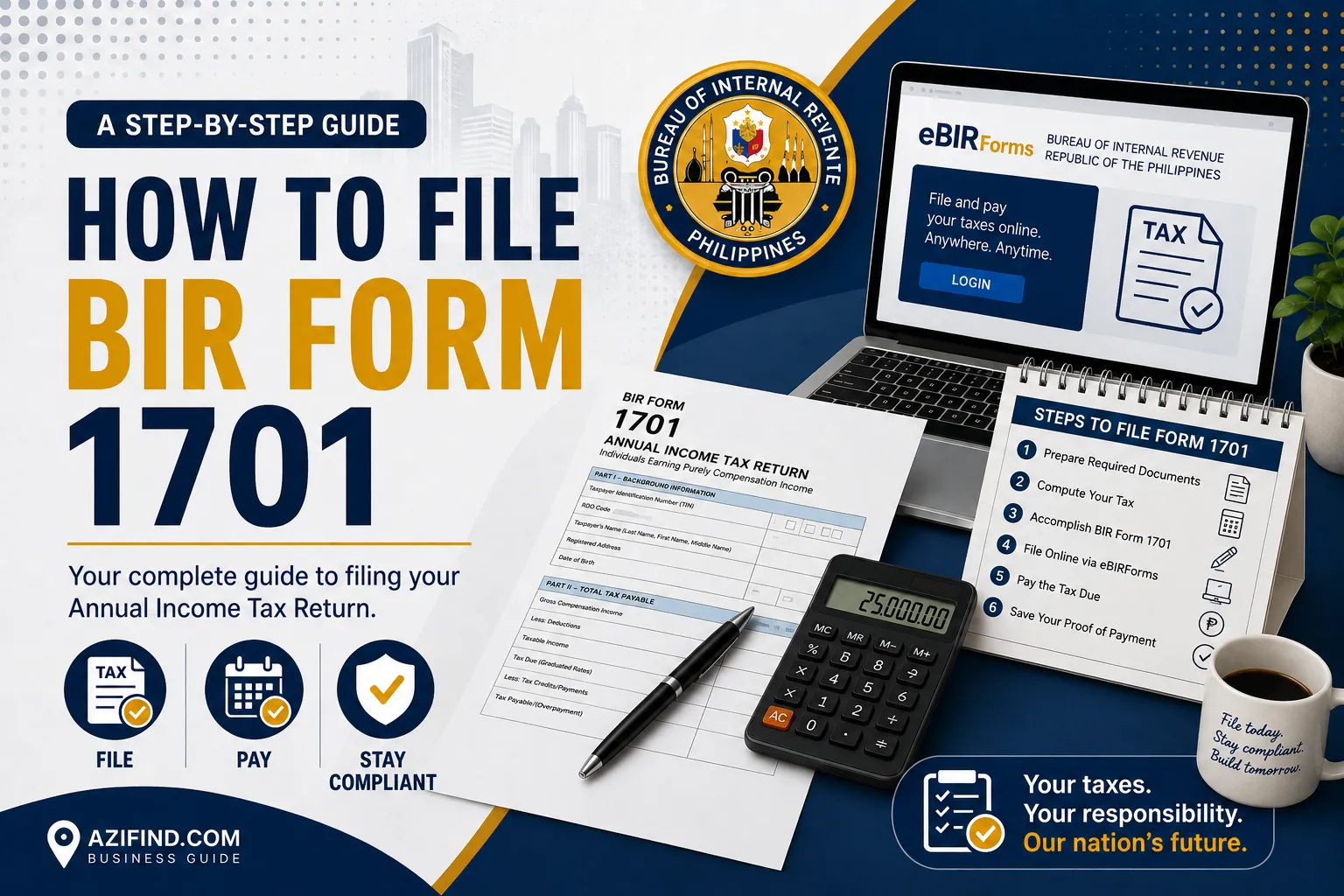
The annual income tax return is the year-end reckoning. It totals your full-year income, settles the fourth quarter you did not file quarterly, and reconciles the whole thing against the tax you already paid through the year.
It is the last stop in the filing cycle. Here is which form to use, when it is due, how the reconciliation works, and what to attach.
Key Takeaways
- The annual return is due April 15 and settles both the fourth quarter and the whole year.
- Use Form 1701A if you earn purely from business or profession on the 8% rate or graduated with OSD.
- Use Form 1701 if you are a mixed-income earner or you itemize deductions.
- The annual tax is reduced by the quarterly income tax you paid and any creditable withholding.
- An overpayment is refunded or, more often, carried forward against next year's tax.
The Filing Year at a Glance
Deadlines for a calendar-year taxpayer. Percentage tax rows apply only if you chose graduated rates, not the 8%.
2551Q
Percentage tax, Q4 of last year
1701
this guideAnnual income tax return
2551Q
Percentage tax, Q1
1701Q
Quarterly income tax, Q1
2551Q
Percentage tax, Q2
1701Q
Quarterly income tax, Q2
2551Q
Percentage tax, Q3
1701Q
Quarterly income tax, Q3
File even for a quarter with zero income. A missed nil return still accrues penalties.
1701 or 1701A: Which You File
There are two annual forms for individuals, and picking the right one saves you trouble.
The simpler one
For individuals earning purely from business or profession who use the 8% flat rate, or the graduated rates with the 40% OSD. Most solo freelancers land here.
The fuller one
For mixed-income earners who also have a salary, for those using itemized deductions, or with other reportable income.
If your tax-rate choice is not settled, the 8% vs graduated guide covers it, since it also determines your form.
When It Is Due
The annual return is due April 15 of the following year for a calendar-year taxpayer. That one date does double duty: it settles the fourth quarter, which is why there is no fourth-quarter 1701Q, and it closes the full year. Miss it and the 25% surcharge and 12% annual interest apply just as they do to any late return.
How the Reconciliation Works
The annual return recomputes your tax on the full year, then credits everything you already paid. You do not pay the whole year's tax again, only the remaining balance.
The reconciliation, in order
If the credits had exceeded the annual tax, the result would be an overpayment to refund or carry forward instead.
What to Attach
Which attachments you need depends on your situation, but the common ones are:
- Forms 2307 for any creditable withholding you are claiming.
- A Summary Alphalist of Withholding Taxes (SAWT) to support those 2307s.
- Form 2316 from your employer, if you are a mixed-income earner.
- Audited financial statements, if you use itemized deductions and your gross exceeds the threshold that requires them.
Keeping these organized through the year is what good recordkeeping is for.
How to File It
Prepare the return in eBIRForms or eFPS, submit electronically, and pay any balance through a BIR ePayment channel, an Authorized Agent Bank, or the Revenue Collection Officer. The attachments are submitted according to the current BIR procedure, often through the eAFS system. The channels are covered in how to pay your BIR taxes.
Find a Digital Marketing Agency Near You
Prefer to hand this off? These providers are listed in the azifind directory. Compare and shortlist before you commit.
Deloitte Philippines (Cebu office)
Philippines
Diaz Murillo Dalupan and Company Cebu Branch
Philippines
DMA Global Accounting Services Co.
Philippines
Espina Perez- Espina & Associates
Philippines
FCO Accountants
Philippines
Hermosada & Co., CPA's
Philippines
Lily Villamala Ceniza and Associates ( LVCA )
Philippines
MB&A CPAS
Philippines
Mora, Sanchez, Meñoza and Associates or MSMA (formerly R. P. Mora & Co.)
Philippines
R Talaba Accounting Firm
Philippines
Common Annual Return Mistakes to Avoid
The most common is filing the wrong form. A mixed-income earner who files 1701A instead of 1701, or an itemizer who uses 1701A, files an incorrect return.
The second is paying the full annual tax again, forgetting to credit the quarterly payments and withholding. The annual return only collects the balance.
The third is not carrying forward an overpayment, which leaves money sitting with the BIR instead of reducing next year's tax.
The fourth is missing attachments, especially the 2307s and SAWT, which can hold up the return or lose you the withholding credit.
One Last Thing
If you filed your quarterly returns cleanly and kept your 2307s together, the annual return is mostly arithmetic: total the year, subtract what you paid, settle the difference by April 15. The taxpayers who dread April are usually the ones who skipped quarters or lost their records, so the real work happens all year, not in one night before the deadline.
Frequently Asked Questions
What is the difference between Form 1701 and Form 1701A?
Form 1701A is the simpler return for individuals earning purely from business or profession who use the 8% flat rate or the graduated rates with the 40% Optional Standard Deduction. Form 1701 is for mixed-income earners, or for those using itemized deductions, or with other reportable income. If you have a salary alongside your freelance income, or you itemize, you use 1701.
When is the annual income tax return due?
April 15 of the following year for a calendar-year taxpayer. That single date settles the fourth quarter and the whole year at once, which is why there is no separate fourth-quarter 1701Q.
If I filed my quarterly returns, do I still file annually?
Yes. The annual return is separate and mandatory. It recomputes the tax on your full-year income, then subtracts the quarterly income tax you already paid and any creditable withholding, leaving a small balance to pay or an overpayment to carry forward.
What happens if I overpaid during the year?
If your quarterly payments and withheld tax add up to more than your annual tax, you have an overpayment. On the return you elect to have it refunded or, more commonly, carried forward as a credit against next year's tax.
What do I attach to the annual return?
Commonly the Forms 2307 for creditable withholding, a Summary Alphalist of Withholding Taxes (SAWT) to support them, and, for a mixed-income earner, the Form 2316 from your employer. Taxpayers using itemized deductions above the threshold may also need audited financial statements.
Does an 8% filer still file the annual return?
Yes. An 8% filer earning purely from business or profession files Form 1701A annually, applying the 8% to full-year gross receipts above P250,000 and crediting the quarterly payments already made.
Year closed out? Get found next year too
Filing your annual return keeps your business in good standing. A listing keeps it visible year round. Claim or add your free listing on azifind to appear on the city and category pages people use to find businesses like yours.