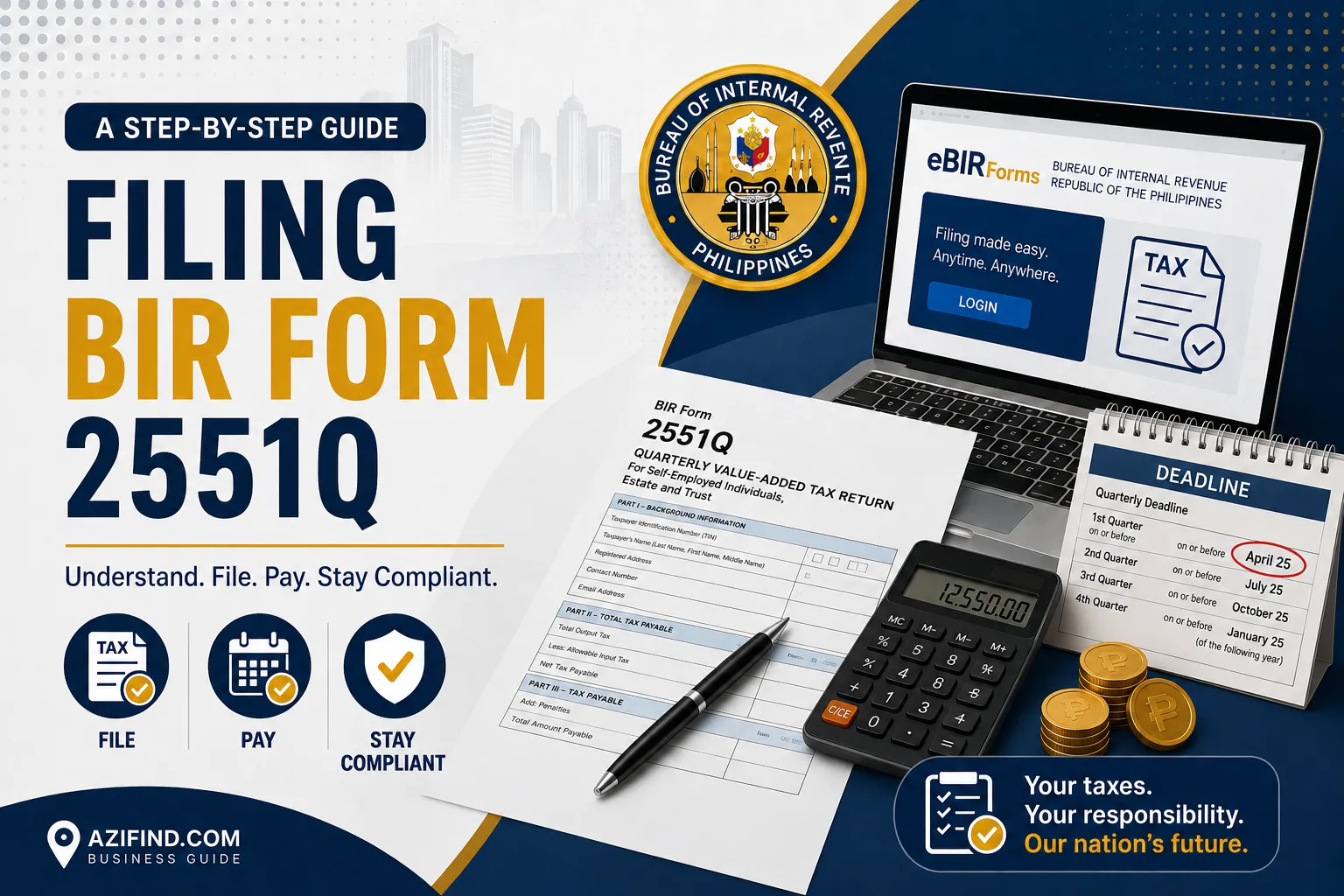
Percentage tax is the return that splits self-employed taxpayers in two. If you chose the graduated rates, you file it every quarter. If you chose the 8% flat rate, you never touch it. That single fork is the most important thing to get right here.
It is part of the filing cycle, and it only applies to graduated filers. Here is the rate, the deadlines, and how to compute it.
Key Takeaways
- Only graduated-rate, non-VAT filers under P3 million pay 2551Q. The 8% flat rate covers it, so 8% filers skip it.
- The rate is 3% of gross receipts. It reverted to 3% from a temporary 1% on July 1, 2023.
- It is due within 25 days after each quarter: April 25, July 25, October 25, and January 25.
- Unlike income tax, it is computed per quarter on that quarter's gross, not cumulatively.
- Cross P3 million and you register for VAT, filing VAT returns instead.
The Filing Year at a Glance
Deadlines for a calendar-year taxpayer. Percentage tax rows apply only if you chose graduated rates, not the 8%.
2551Q
this guidePercentage tax, Q4 of last year
1701
Annual income tax return
2551Q
this guidePercentage tax, Q1
1701Q
Quarterly income tax, Q1
2551Q
this guidePercentage tax, Q2
1701Q
Quarterly income tax, Q2
2551Q
this guidePercentage tax, Q3
1701Q
Quarterly income tax, Q3
File even for a quarter with zero income. A missed nil return still accrues penalties.
Who Files It, and Who Does Not
Percentage tax applies to non-VAT taxpayers whose gross receipts stay under the P3 million VAT threshold. But within that group, only one path files it.
You file 2551Q
If you chose the graduated income tax rates, the 3% percentage tax is a separate quarterly return you file on top of your income tax.
You skip it entirely
The 8% flat rate is in lieu of both income tax and percentage tax, so you never file 2551Q. Filing it anyway would be double-paying.
Not sure which you chose? The 8% vs graduated guide explains the election that decides this.
The Rate Is Back to 3%
Percentage tax is 3% of your gross sales or receipts. Watch out for older guides here: under the CREATE Law the rate was temporarily cut to 1% from July 1, 2020, but it reverted to 3% effective July 1, 2023. Any guide still showing 1% is out of date.
When It Is Due
2551Q is due within 25 days after the end of each taxable quarter:
- Q1, January to March, is due April 25.
- Q2, April to June, is due July 25.
- Q3, July to September, is due October 25.
- Q4, October to December, is due January 25 of the following year.
Note the difference from income tax: all four quarters are filed on 2551Q, including the fourth. There is no annual percentage tax return that absorbs the last quarter.
How to Compute It
The math is simple, and unlike the income tax return it is not cumulative. Each quarter stands on its own: take that quarter's gross receipts and multiply by 3%.
Per-quarter example
No P250,000 deduction and no running total. Each quarter is computed fresh on its own gross.
How to File It
Prepare 2551Q in eBIRForms or eFPS and pay through a BIR ePayment channel, an Authorized Agent Bank, or the Revenue Collection Officer. As with every return, a quarter with no receipts is still filed as a nil return. The payment channels are covered in how to pay your BIR taxes.
When Percentage Tax Ends
Percentage tax is a feature of being a small, non-VAT taxpayer. Once your gross sales or receipts exceed P3 million in a year, you are required to register for VAT. From that point you file VAT returns at 12% instead of the percentage tax, and the 8% option is no longer available to you. Crossing the threshold is a meaningful shift, so track your running gross through the year.
Find a Digital Marketing Agency Near You
Prefer to hand this off? These providers are listed in the azifind directory. Compare and shortlist before you commit.
Deloitte Philippines (Cebu office)
Philippines
Diaz Murillo Dalupan and Company Cebu Branch
Philippines
DMA Global Accounting Services Co.
Philippines
Espina Perez- Espina & Associates
Philippines
FCO Accountants
Philippines
Hermosada & Co., CPA's
Philippines
Lily Villamala Ceniza and Associates ( LVCA )
Philippines
MB&A CPAS
Philippines
Mora, Sanchez, Meñoza and Associates or MSMA (formerly R. P. Mora & Co.)
Philippines
R Talaba Accounting Firm
Philippines
Common 2551Q Mistakes to Avoid
The most common is an 8% filer paying it anyway. If you elected 8%, you do not file 2551Q, and paying it is money handed over twice.
The second is using the old 1% rate. It reverted to 3% in mid-2023, so a return computed at 1% understates the tax.
The third, for graduated filers, is forgetting it entirely while paying income tax. It is a separate return with its own deadline, 25 days after the quarter.
The fourth is not tracking gross toward the P3 million line, then missing the point where VAT registration became required.
One Last Thing
Percentage tax is the simplest return you file, once you know whether you file it at all. Graduated filers: gross times 3%, every quarter, 25 days after it ends. Everyone on 8%: nothing to do here. If you are still weighing the two rates, that decision, which removes or keeps this whole return, is in the 8% vs graduated guide.
Frequently Asked Questions
Who has to file percentage tax on Form 2551Q?
Non-VAT self-employed individuals whose gross sales or receipts stay under the P3 million VAT threshold and who chose the graduated income tax rates. If you elected the 8% flat rate, you do not file 2551Q at all, because the 8% already includes the percentage tax.
What is the percentage tax rate?
It is 3% of your gross sales or receipts. The rate was temporarily reduced to 1% under the CREATE Law from July 1, 2020, but it reverted to 3% effective July 1, 2023, so 3% is the current rate.
When is 2551Q due?
Within 25 days after the end of each taxable quarter, so the usual dates are April 25, July 25, October 25, and January 25 for the fourth quarter. Unlike the income tax return, all four quarters are filed on 2551Q, including the last one.
Is percentage tax cumulative like the income tax return?
No. This is a key difference. Percentage tax is computed on each quarter's gross receipts on its own, not on a running year-to-date total. You do not carry forward or subtract prior quarters as you do on 1701Q.
Do 8% filers ever file 2551Q?
No. Electing the 8% flat rate is precisely a way to avoid the percentage tax, since the single 8% covers both income tax and percentage tax. If you see an 8% filer also paying 2551Q, something has been filed in error.
What happens if I cross the P3 million threshold?
Once your gross sales or receipts exceed P3 million, you are required to register for VAT. You then file VAT returns instead of the percentage tax, and you can no longer use the 8% option.
Returns handled? Get found too
Filing your quarterly returns on time keeps your business in good standing. A listing keeps it visible. Claim or add your free listing on azifind to appear on the city and category pages people use to find businesses like yours.