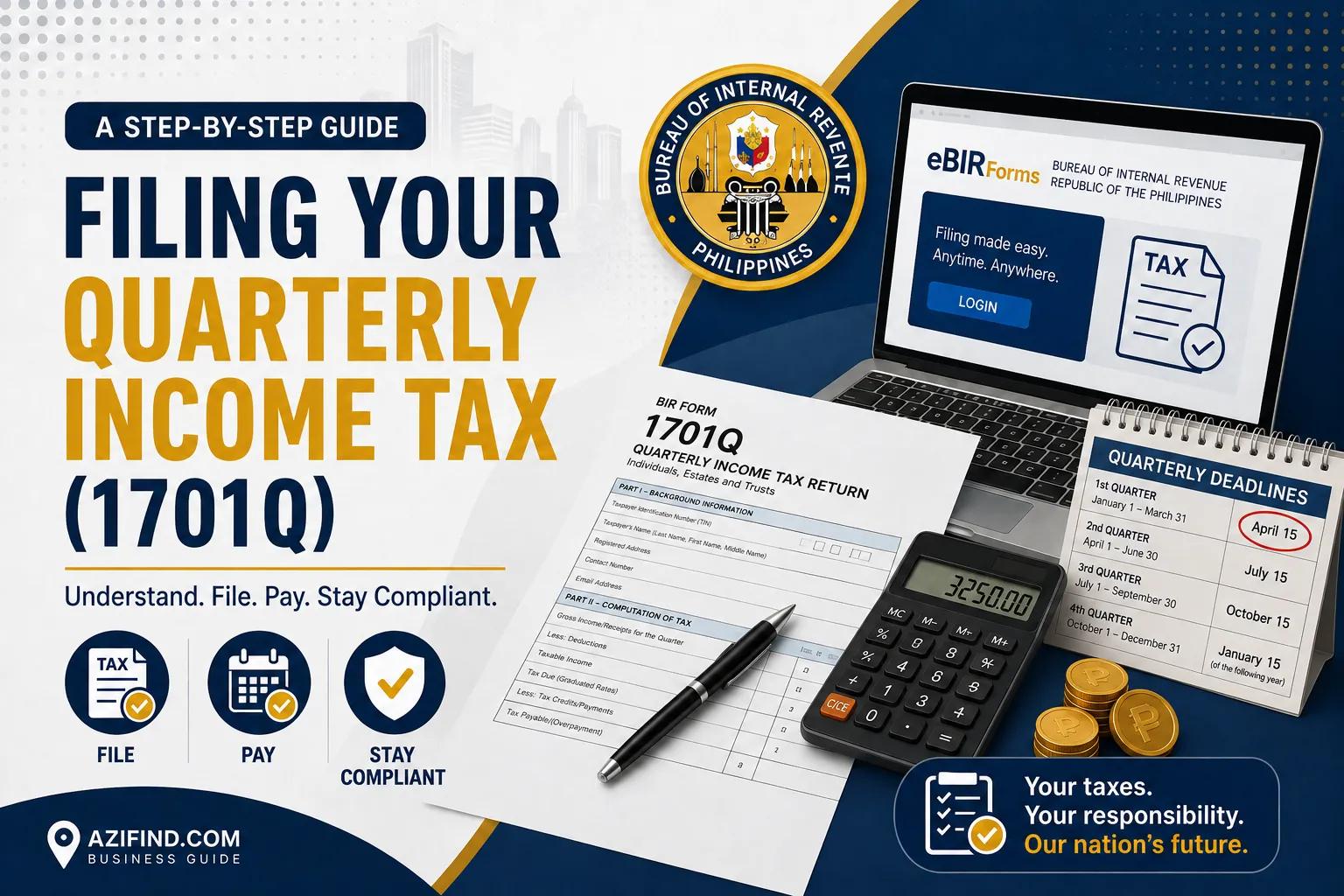
Form 1701Q is the quarterly income tax return every self-employed Filipino files three times a year. It is not complicated, but it has one feature that confuses almost everyone the first time: it is cumulative, so each quarter carries forward the ones before it.
This is one of the returns in the filing cycle. Here is who files it, when, how the running total works, and how to compute it whether you are on the 8% or the graduated rate.
Key Takeaways
- 1701Q is due three times a year: May 15, August 15, and November 15. The fourth quarter is settled in the annual 1701.
- The computation is cumulative. You compute tax on the year-to-date total, then subtract what you paid in earlier quarters.
- Both 8% and graduated filers file 1701Q. The method of computing the tax differs.
- A quarter with no income still requires a nil return.
- Tax a client withheld, shown on Form 2307, is a credit against what you owe.
The Filing Year at a Glance
Deadlines for a calendar-year taxpayer. Percentage tax rows apply only if you chose graduated rates, not the 8%.
2551Q
Percentage tax, Q4 of last year
1701
Annual income tax return
2551Q
Percentage tax, Q1
1701Q
this guideQuarterly income tax, Q1
2551Q
Percentage tax, Q2
1701Q
this guideQuarterly income tax, Q2
2551Q
Percentage tax, Q3
1701Q
this guideQuarterly income tax, Q3
File even for a quarter with zero income. A missed nil return still accrues penalties.
Who Files It, and When
Self-employed individuals, professionals, and mixed-income earners all file 1701Q for their business or professional income. The three deadlines cover the first three quarters:
- Q1, January to March, is due May 15.
- Q2, April to June, is due August 15.
- Q3, July to September, is due November 15.
There is no Q4 1701Q. The fourth quarter is folded into the annual return, Form 1701, due April 15 of the following year.
The Cumulative Computation, Explained
Each 1701Q covers the year to date, not just the three months of that quarter. You add up your income from January to the end of the current quarter, compute the tax on that running total, then subtract the tax you already paid in earlier quarters. Whatever remains is what you pay now.
Worked example, 8% filer
Q1: gross P150,000
Q2: gross P200,000
Q3: gross P180,000
The P250,000 tax-free amount is applied once against the running total, which is why Q1 came out at zero.
Computing It Under Each Rate
On the 8% flat rate, you apply 8% to cumulative gross receipts above P250,000, as in the example above, then subtract prior quarters. A mixed-income earner computes on full gross receipts, because the P250,000 is already used on the salary side.
On the graduated rates, you compute cumulative net taxable income first, deducting either your itemized expenses or the 40% Optional Standard Deduction, then apply the graduated table, then subtract prior quarters and any creditable withholding. If the choice between the two rates is not yet settled for you, the 8% vs graduated guide covers it.
Claiming Tax a Client Withheld
If a corporate client withheld Expanded Withholding Tax from your fee, they give you a Form 2307. That amount is not lost. On your 1701Q you enter it as creditable withholding tax, which reduces the tax you pay for the quarter, and you attach the 2307 to support it. If the credits exceed your tax, the overpayment carries forward. Online sellers whose marketplace withheld the 1% remittance tax claim it the same way.
How to File It
Prepare the return in the eBIRForms offline package or in eFPS, then submit electronically. Pay through a BIR ePayment channel, an Authorized Agent Bank, or the Revenue Collection Officer at your RDO. A nil return is still submitted the same way. The full payment walkthrough is in how to pay your BIR taxes.
Find a Digital Marketing Agency Near You
Prefer to hand this off? These providers are listed in the azifind directory. Compare and shortlist before you commit.
Deloitte Philippines (Cebu office)
Philippines
Diaz Murillo Dalupan and Company Cebu Branch
Philippines
DMA Global Accounting Services Co.
Philippines
Espina Perez- Espina & Associates
Philippines
FCO Accountants
Philippines
Hermosada & Co., CPA's
Philippines
Lily Villamala Ceniza and Associates ( LVCA )
Philippines
MB&A CPAS
Philippines
Mora, Sanchez, Meñoza and Associates or MSMA (formerly R. P. Mora & Co.)
Philippines
R Talaba Accounting Firm
Philippines
Common 1701Q Mistakes to Avoid
The most common is computing each quarter on its own instead of cumulatively. Forgetting to subtract prior payments makes you overpay; forgetting to add earlier income makes you underpay and face a shortfall later.
The second is missing the May 15 first-quarter deadline, which is often mistaken for April 15. Those are two different returns.
The third is skipping a nil quarter. Zero income still means a filed return.
The fourth is not claiming your Form 2307 credits, which means paying tax a client already remitted on your behalf.
One Last Thing
Once the cumulative logic clicks, 1701Q is routine: total the year so far, compute, subtract what you already paid, file. Keep a simple running tally of income and withheld tax through the year and each quarter takes minutes. When the year closes, it all reconciles in the annual return.
Frequently Asked Questions
Who files BIR Form 1701Q?
Self-employed individuals, professionals, and mixed-income earners file 1701Q for their business or professional income. You file it whether you chose the 8% flat rate or the graduated rates, and whether or not you earned anything that quarter.
When is Form 1701Q due?
It is due three times a year: May 15 for the first quarter, August 15 for the second, and November 15 for the third. The fourth quarter is not filed on a 1701Q. It is settled in the annual return, Form 1701, due April 15 of the following year.
Why is the computation cumulative?
Each 1701Q covers the year to date, not just the single quarter. You total your gross or net income from January up to the end of the current quarter, compute the tax on that running total, then subtract the tax you already paid in earlier quarters. This keeps the year self-correcting and avoids double-counting.
Do I file 1701Q if I had no income that quarter?
Yes. A quarter with zero income still requires a filed return showing zero, a nil return. The penalty applies to not filing, so an empty quarter is filed, not skipped.
How do I claim tax a client already withheld?
If a client withheld Expanded Withholding Tax and gave you a Form 2307, that amount is a credit against your quarterly income tax. You enter it as creditable withholding and attach the 2307, which reduces what you pay or creates an overpayment you carry forward.
How do I actually file it?
Most self-employed taxpayers prepare 1701Q in the eBIRForms offline package or in eFPS, then pay through a BIR ePayment channel, an Authorized Agent Bank, or the Revenue Collection Officer. Even a nil return is submitted electronically.
Filing on time? Get found too
Staying current on your quarterly returns keeps your business in good standing. A listing keeps it visible. Claim or add your free listing on azifind to appear on the city and category pages people use to find businesses like yours.