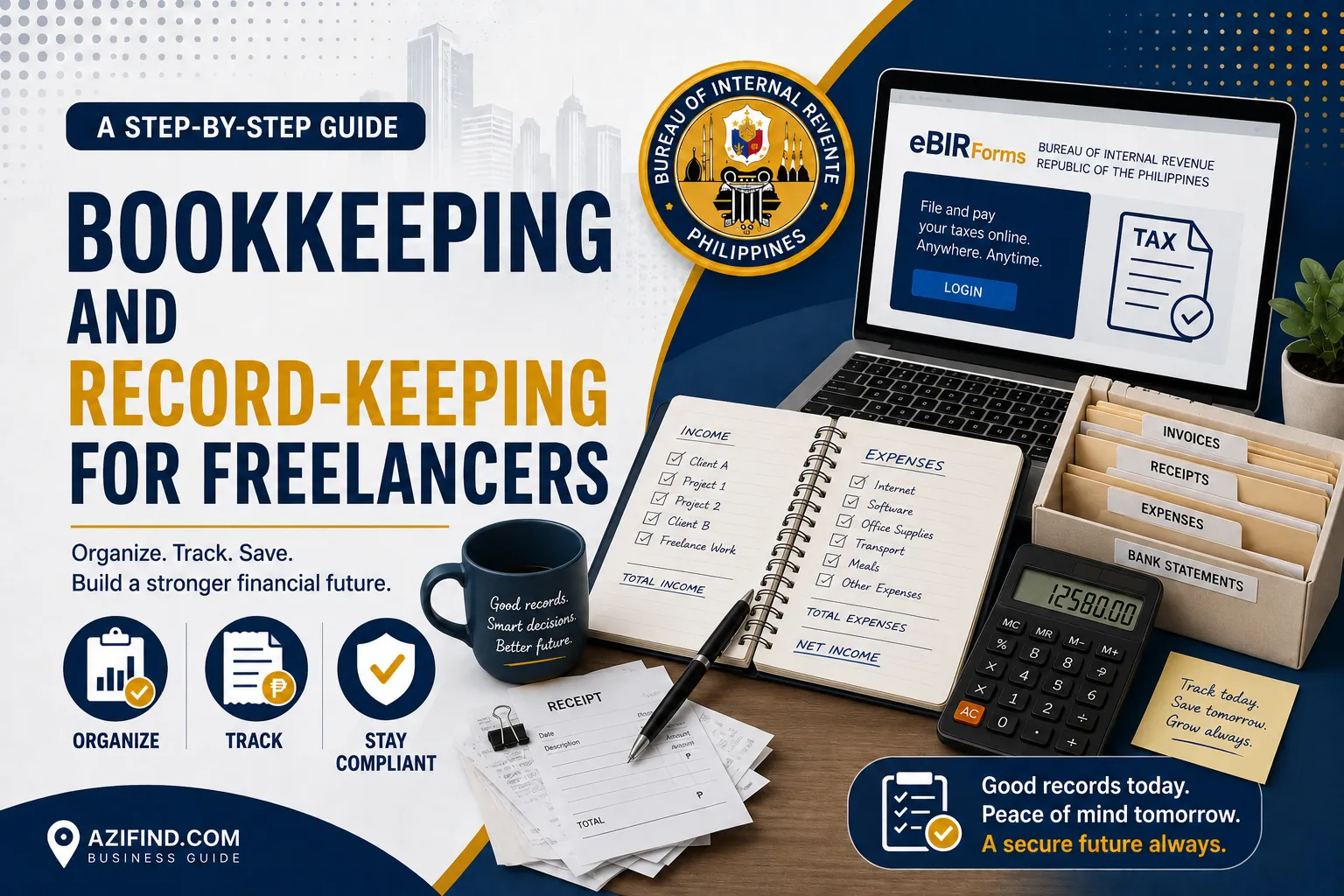
Every return you file rests on records. Keep them well and filing is a quick copy from a tidy ledger. Keep them badly and every deadline becomes a scramble, and an audit becomes a real problem.
Record-keeping is the quiet foundation under the whole filing cycle. Here is what the BIR requires you to keep, how long to keep it, and a system light enough to maintain alongside real work.
Key Takeaways
- You must keep registered books of accounts, at minimum a journal and a ledger, even on the 8% rate.
- Books are registered before use, in manual, loose-leaf, or computerized form, now largely through ORUS.
- Keep the documents behind every return: issued invoices, Forms 2307, expense proof, filed returns, and payment proof.
- Records are preserved for 10 years: hard copy for the first 5, and electronic for the next 5.
- Clean records let you claim credits and deductions and turn an audit into a simple document request.
The Filing Year at a Glance
Deadlines for a calendar-year taxpayer. Percentage tax rows apply only if you chose graduated rates, not the 8%.
2551Q
Percentage tax, Q4 of last year
1701
Annual income tax return
2551Q
Percentage tax, Q1
1701Q
Quarterly income tax, Q1
2551Q
Percentage tax, Q2
1701Q
Quarterly income tax, Q2
2551Q
Percentage tax, Q3
1701Q
Quarterly income tax, Q3
File even for a quarter with zero income. A missed nil return still accrues penalties.
Your Books of Accounts
Every registered taxpayer keeps books of accounts, at minimum a journal and a ledger. You have three formats to choose from:
- Manual booklets, the simplest and most common for solo freelancers.
- Loose-leaf, printed from a spreadsheet or software and bound, registered periodically.
- Computerized (CAS), a registered accounting system, suited to higher volume.
Choosing the 8% rate simplifies your tax computation, but it does not remove the duty to keep books. Everyone maintains them.
Register Them Before You Use Them
Books must be registered with the BIR before you record anything in them, and registration now runs largely through ORUS. This is one of the post-registration setup steps on the registration hub, alongside getting your invoices. Recording in unregistered books is a compliance gap, so register first, then write.
What Goes in the Books
For a freelancer, the entries are straightforward:
- Income, each payment received, matched to the invoice you issued.
- Tax withheld, the amounts on any Forms 2307, which you will credit later.
- Expenses, if you use itemized deductions under graduated rates. On the 8% rate or the 40% OSD you do not deduct actual expenses, but keeping the record is still good practice.
A running tally of these through the year is exactly what makes the cumulative 1701Q and the annual return quick to prepare.
The Documents to Keep
Your books summarize; these documents prove. Keep a copy of each:
Income side
- The invoices you issued to clients
- Forms 2307 for tax clients withheld
- Platform payout records, for online income
Filing side
- Every filed return, quarterly and annual
- Proof of payment for each
- Expense receipts, if you itemize
The Forms 2307 matter most, because without them you cannot claim the withholding credit on your return and end up paying tax a client already remitted.
Keep Everything for Ten Years
The preservation period is long, so plan storage for it from the start.
5
years in hard copy
+5
years electronic is allowed
Ten years total, counted from the deadline or filing date of the related return.
In practice, keep the physical books and documents for the first five years, then you may convert to electronic copies for the remaining five. Do not discard anything until the full ten years have passed.
A System You Can Actually Keep
You do not need accounting software to stay compliant. A workable freelancer setup is simple: record each payment in your registered books when it arrives, drop a scan of every invoice, 2307, and payment confirmation into a dated folder, and keep a one-line spreadsheet of income and withheld tax by month. That tally feeds every return directly, and the folder is your audit file if it is ever needed. If your volume or complexity grows, that is the point to bring in a bookkeeper.
Find a Digital Marketing Agency Near You
Prefer to hand this off? These providers are listed in the azifind directory. Compare and shortlist before you commit.
Deloitte Philippines (Cebu office)
Philippines
Diaz Murillo Dalupan and Company Cebu Branch
Philippines
DMA Global Accounting Services Co.
Philippines
Espina Perez- Espina & Associates
Philippines
FCO Accountants
Philippines
Hermosada & Co., CPA's
Philippines
Lily Villamala Ceniza and Associates ( LVCA )
Philippines
MB&A CPAS
Philippines
Mora, Sanchez, Meñoza and Associates or MSMA (formerly R. P. Mora & Co.)
Philippines
R Talaba Accounting Firm
Philippines
Common Record-Keeping Mistakes to Avoid
The most common is recording in unregistered books, which does not count. Register them before the first entry.
The second is losing Forms 2307, which means losing the withholding credit and overpaying your income tax.
The third is assuming the 8% rate excuses bookkeeping. It does not. Books are required regardless of your tax rate.
The fourth is throwing out records too soon. The preservation period is ten years, not the one or two most people assume.
One Last Thing
Bookkeeping feels like overhead until the first time it saves you: a client asks for proof, a deadline arrives, or the BIR sends a notice, and everything you need is already in one folder. Ten minutes a week keeping records current is the cheapest insurance a self-employed person can buy. With that in place, you have completed the full journey from registering to filing and staying compliant.
Frequently Asked Questions
What books of accounts does a freelancer need?
At a minimum, a journal and a ledger. You can keep them as manual booklets, in a loose-leaf format, or through a registered computerized system. Whichever you choose, the books must be registered with the BIR before you start recording in them, which is now handled largely through ORUS.
How long do I have to keep my records?
Ten years. Under the Tax Code and its regulations, books of accounts and supporting records are preserved for ten years. The first five years must be kept in hard copy, and for the remaining five years they may be kept electronically.
Do I still need books if I chose the 8% flat rate?
Yes. The 8% rate simplifies how your tax is computed, but it does not remove the duty to keep and register books of accounts. Every registered taxpayer maintains books regardless of the rate elected.
Which documents should I hold on to?
The invoices you issue, the Forms 2307 clients give you for withheld tax, receipts and proof for any expenses you deduct, your filed returns, and your proof of payment for each. These are the evidence behind the figures on your returns.
Why does record-keeping matter so much?
Because every return you file is only as defensible as the records behind it. Clean records let you claim your withholding credits and deductions, make quarterly and annual filing fast, and turn a BIR audit from a crisis into a document request.
Can I keep everything digitally?
Source documents can be scanned and organized digitally, and the later years of the preservation period may be electronic. The registered books themselves follow the format you registered, whether manual, loose-leaf, or a computerized system, so keep that consistent.
Records in order? Get found too
Clean books keep your business audit-ready. A listing keeps it visible. Claim or add your free listing on azifind to appear on the city and category pages people use to find businesses like yours.